Against the backdrop of global warming, tropical cyclones (TCs) are exhibiting complex responses to climate change. On the one hand, cyclone intensification rates are accelerating and rapid intensification events have increased markedly; on the other hand, the distribution of tropical cyclone lifetime maximum intensity (LMI) is undergoing systematic adjustments. These phenomena indicate that the response of tropical cyclones to climate change is not a univariate process and requires investigation from multiple perspectives. To address this issue, the research group led by Professor Lin Yanluan from the Department of Earth System Science (DESS) at Tsinghua University has recently conducted a series of studies. Exploring the mechanisms of tropical cyclone intensity changes, the research focuses on the impacts of oceanic cold wakes on variations in intensification rates and the role of timescale constraints in the evolution of intensity distributions.
Cold wakes refer to sea surface cooling caused by the intense mixing of the upper ocean by moving tropical cyclones. This process inhibits further cyclone intensification by reducing sea surface temperature and air-sea enthalpy fluxes, serving as a key mechanism in typhoon-ocean interactions. While cold wake effects have been studied in case studies and on short timescales, their long-term climatological evolution and contributions to trends in tropical cyclone intensification remain poorly understood. To fill this gap, the study analyzed the long-term variability of tropical cyclone cold wakes using 42 years of observational data from 1982 to 2023. The results show that the spatial scale of cold wakes generated by tropical cyclones is shrinking significantly, at an average rate of approximately 7% per decade. This trend is robust across different cold wake identification thresholds (Figure 1).
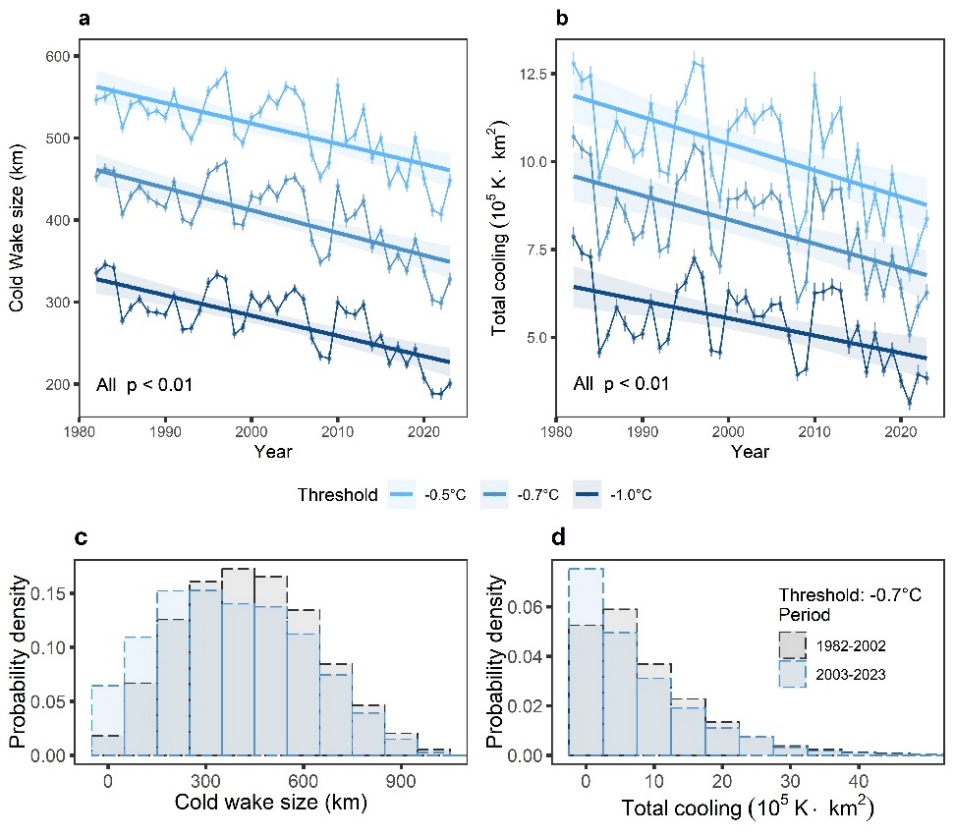
Figure 1 Long-term trends in the spatial size and total cooling of tropical cyclone cold wakes under different identification thresholds
Further analysis reveals that the contraction of cold wake spatial extent is closely linked to the persistent stratification strengthening of the upper ocean. Based on this finding, the study quantitatively assessed the impact of shrinking cold wakes on tropical cyclone intensification trends, showing that this phenomenon can explain about 13% of the observed increase in global tropical cyclone intensification rates in recent decades. This discovery indicates that changes in sea surface cooling effects may have played an important role in tropical cyclone intensification over the past decades.
Relevant findings have been published in the journal npj Climate and Atmospheric Science under the title "Shrinking cold wakes accelerate tropical cyclone intensification in recent decades". Zhou Yufeng, a PhD candidate in Prof. Lin Yanluan's research group at Tsinghua DESS, is the first author, and Prof. Lin Yanluan is the corresponding author. Shan Kaiyue, Assistant Professor at the Department of Hydraulic Engineering, Tsinghua University, is a co-author of the study. The research was supported by the National Natural Science Foundation of China (Grant No. 42130603).
Another study focused on the evolutionary characteristics of the tropical cyclone LMI distribution. Observations show that the global LMI distribution has become increasingly bimodal in recent years, with concurrent increases in the proportion of both weak and intense cyclones. To explain this pattern, the study proposed a rate-duration framework, which decomposes tropical cyclone LMI into two fundamental components: intensification rate and intensification duration. Analysis of global observational data reveals that while intensification rates have risen markedly, intensification duration has shortened continuously, at an average rate of about 1.4 hours (approximately 3.4%) per decade. This change is closely associated with the poleward and landward shifts in tropical cyclone genesis locations.
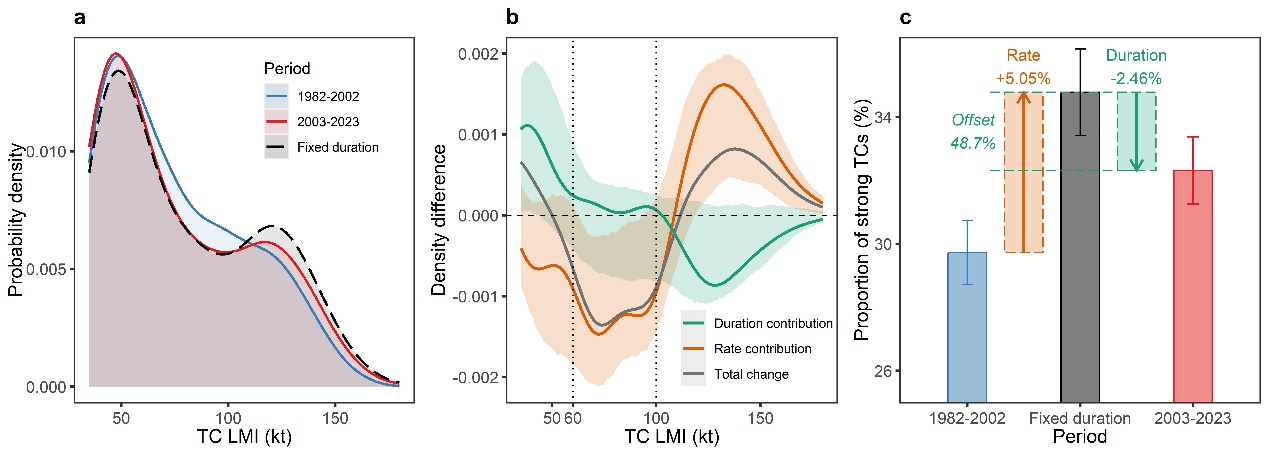
Fig. 2 Relative contributions of intensification rate and duration to the evolution of the tropical cyclone LMI distribution
Subsequent counterfactual analysis demonstrates that the shortening of intensification duration has offset nearly half (approximately 48.7%) of the increase in intense cyclones driven by rising intensification rates, while also contributing to the growth in the proportion of weak cyclones. Together, these two factors drive the evolution of the LMI distribution toward a more pronounced bimodal structure (Fig. 2). Results from high-resolution climate model simulations confirm the robustness of this timescale constraint mechanism, highlighting the critical role of timescale in regulating the evolution of tropical cyclone intensity.
This research has been published in npj Climate and Atmospheric Science under the title "Shortened intensification duration offsets the increase of tropical cyclone lifetime maximum intensity" and was also presented as an oral talk at the 22nd Annual Meeting of the Asia-Oceania Geosciences Society (AOGS 2025). Zhou Yufeng, a PhD candidate in Professor Lin Yanluan's research group at Tsinghua DESS, is the first author, and Professor Lin Yanluan is the corresponding author. The research was supported by the National Natural Science Foundation of China (Grant No. 42130603).
Paper Information:
Zhou, Y., Lin, Y. Shortened intensification duration offsets the increase of tropical cyclone lifetime maximum intensity. npj Clim Atmos Sci (2025). https://doi.org/10.1038/s41612-025-01295-3
Zhou, Y., Shan, K. & Lin, Y. Shrinking cold wakes accelerate tropical cyclone intensification in recent decades. npj Clim Atmos Sci (2025). https://doi.org/10.1038/s41612-025-01300-9
Scan the QR code below or click "Read the Original" to access the full papers.
Full text link: https://doi.org/10.1038/s41612-025-01295-3
Edited by Yufeng Zhou
Reviewed by Lin Yanluan



 Picture News
 Hot News