Against the backdrops of global drought and warming, whether plants can maintain a match between the water supply capacity of sapwood and the transpiration demand of leaves has become a key factor affecting plant survival, which directly influences ecosystem carbon and water cycles. The Huber value (vH; the ratio of sapwood area to leaf area) is an important trait characterizing this supply-demand balance, reflecting plants' hydraulic configuration and carbon allocation strategies under different environments. Although observations have revealed significant differences in vH among species and across climatic zones, the lack of paired hydraulic trait data and the complex coupling between vH and other traits have hindered a unified understanding of the mechanisms driving vH variation along environmental gradients. As a result, vH is often simplified as a fixed parameter per plant functional type in vegetation models, increasing uncertainties in predicting vegetation responses and carbon-water cycles under climate change scenarios.
Recently, the Research Group led by Associate Professor Wang Han from the Department of Earth System Science (DESS) has proposed a plant water supply-demand balance hypothesis based on eco-evolutionary optimality principles. The hypothesis states that plants tend to maintain a balance between water demand and supply under long-term average environmental conditions, such that the transpiration water required to keep stomata open equals the water transported by the xylem. Based on this hypothesis, the group couples leaf-scale gas exchange processes with whole-plant water transport processes to develop a simplified theoretical model of vH that incorporates photosynthesis. This model not only quantitatively characterizes the trade-offs among key hydraulic traits but also provides the theoretical direction and sensitivity of vH variation with major climatic factors (Figure 1).
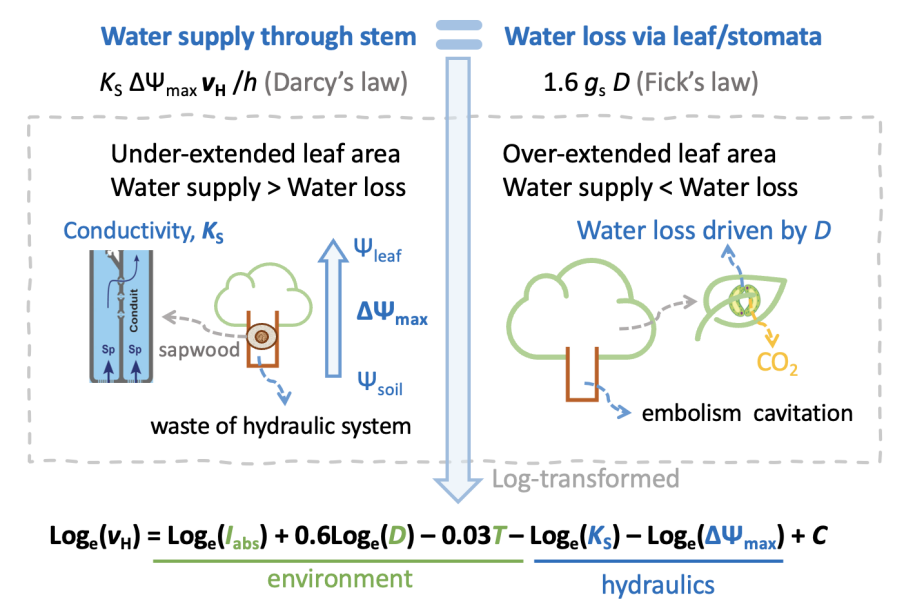
Figure 1 Schematic diagram of the plant water supply-demand balance hypothesis.
The theoretical model is validated using two global hydraulic trait databases at the individual and species levels. Both the model predictions and observational data show that in drier and high-radiation environments, plants require a higher vH to meet greater transpiration demand, i.e., they allocate more sapwood area to support the water needs of a given leaf area. Conversely, under higher temperatures, the viscosity of water decreases with increasing temperature, thereby enhancing hydraulic conductivity and reducing the sapwood investment required to maintain the same leaf area, leading to a lower vH. Furthermore, when hydraulic conductivity and maximum water potential gradient increase, indicating stronger water supply capacity, plants also tend to lower vH, supporting more leaf area with less sapwood (Figure 2). With only one fitted parameter, the model explains 56% of the global variation in the sapwood-to-leaf area ratio (Figure 3), demonstrating that the global pattern of vH is largely explained by the water supply-demand balance hypothesis.
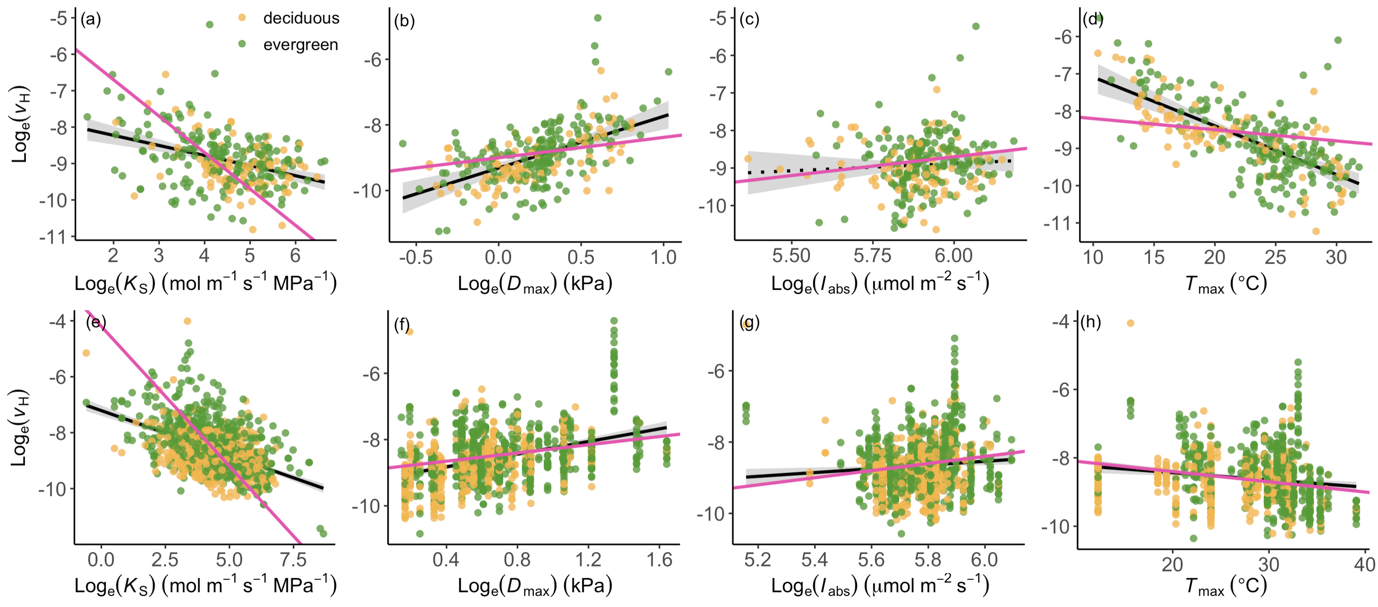
Figure 2 Partial residual plots from multiple linear regression analysis.
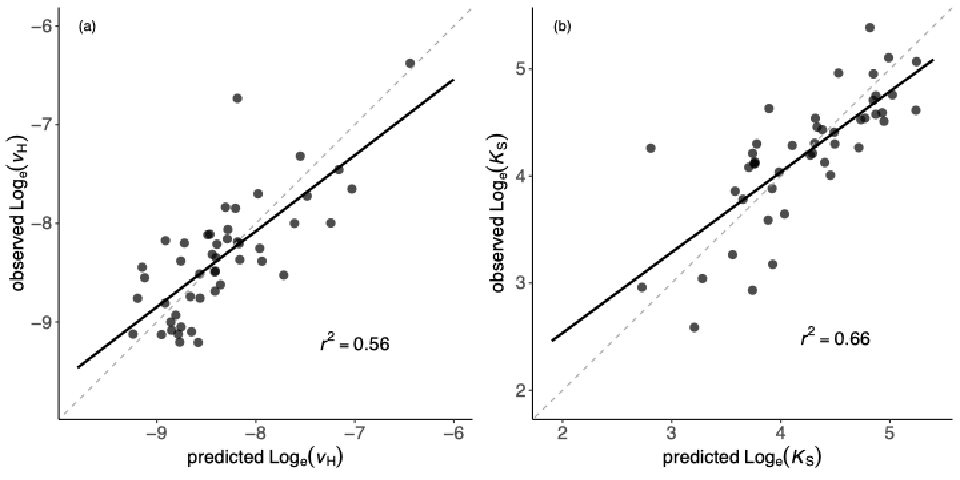
Figure 3 Comparison of observed and predicted sapwood-to-leaf area ratio (vH) and hydraulic conductivity (Kₛ).
The relevant findings, titled "Global variation in the ratio of sapwood to leaf area explained by optimality principles," were published online in New Phytologist. Dr. Xu Huiying (currently a postdoctoral fellow at the University of Utah) from Tsinghua DESS is the first author, and Associate Professor Wang Han is the corresponding author. Co-authors include researchers from the University of Reading, Imperial College London, the University of Exeter, and the South China Botanical Garden. The research was supported by the National Key Research and Development Program of China and the National Natural Science Foundation of China, among other grants.
Full-text link: https://doi.org/10.1111/nph.70916
Written by Xu Huiying



 Picture News
 Hot News