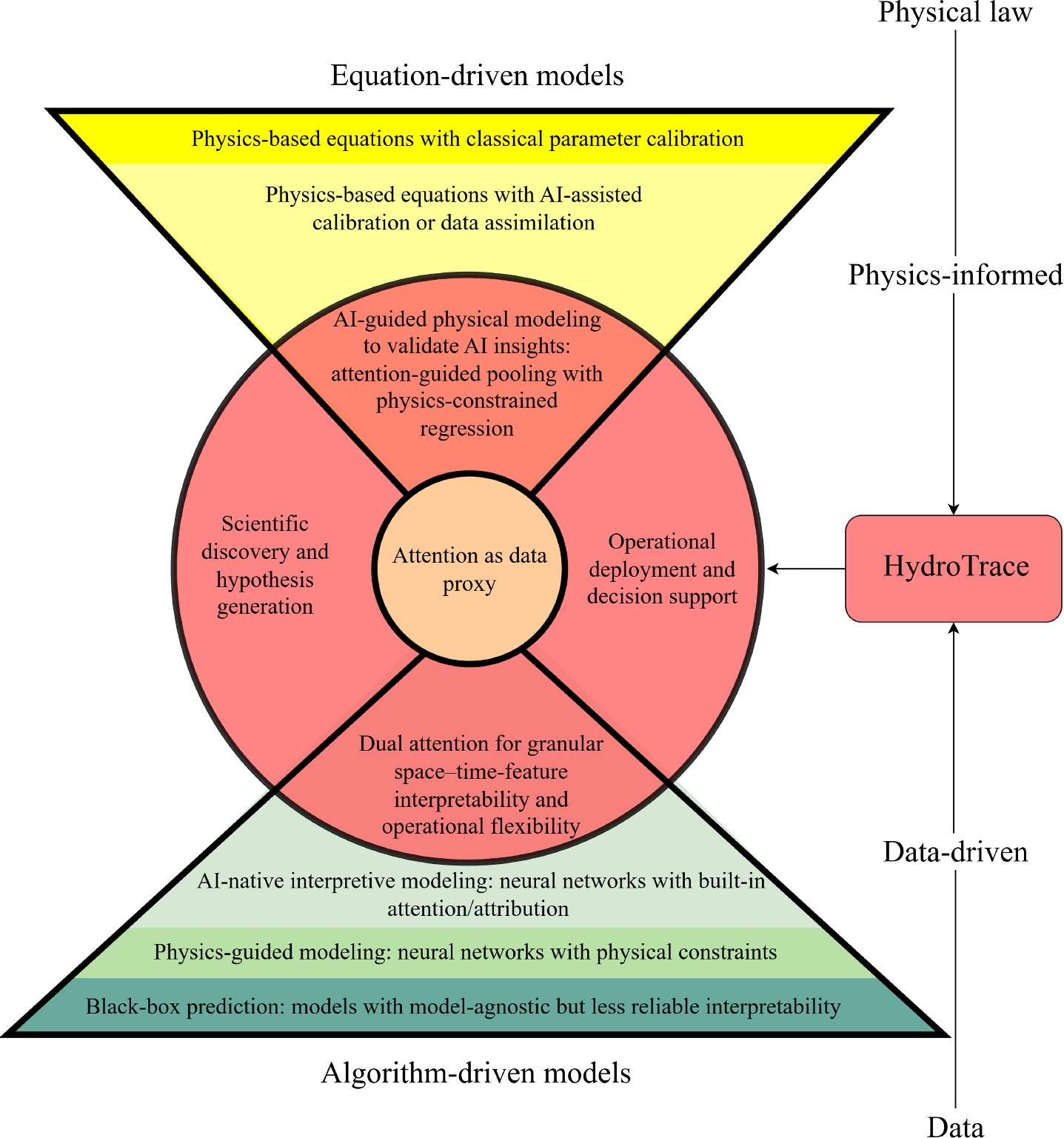
Recently, Academician Chen Deliang from the Department of Earth System Science (DESS) at Tsinghua University, in collaboration with the Institute of Tibetan Plateau Research of the Chinese Academy of Sciences, Alibaba Group, China Electric Power Research Institute of State Grid Corporation of China, Global Energy Interconnection Group Co., Ltd. and other institutions, has developed HydroTrace, an interpretable attention-based AI for glacio-hydrological modeling that integrates cryospheric melt processes. By innovatively fusing AI with physical hydrological mechanisms in depth, the model enables high-precision and highly interpretable simulation and prediction of river runoff on the Tibetan Plateau.
The research team has systematically revealed the year-round glacier influence on runoff across the Tibetan Plateau, finding that glaciers not only modulate runoff during the wet season (ablation period) but also serve as a critical water source sustaining streamflow in the dry season. This discovery provides new scientific evidence for understanding the water cycle mechanisms of the "Asian Water Tower" against the backdrop of climate change.
Unlike traditional "black-box" deep learning models, HydroTrace leverages the Attention Mechanism as a data-informed proxy to achieve transparent mapping of input-output relationships. The model can identify the key drivers of runoff variations at the spatial, temporal and feature levels, and realize the explicit expression of physical hydrological processes through an attention-guided water-balance equation. Studies have shown that HydroTrace’s predictive accuracy at two observational sites on the Tibetan Plateau significantly outperforms existing mainstream models, with a calibrated Nash-Sutcliffe Efficiency (NSE) of up to 0.98, meeting the international "Very Good" range for hydrological model performance.
The research team stated that HydroTrace can serve as a supporting tool for hydrological prediction and operational scheduling in major river basin engineering projects. It enables highly reliable runoff forecasting and risk assessment under complex topographic and climatic conditions, providing a new technical approach for water resource management, hydropower dispatching and climate risk prevention and control in China and even the Pan-Third Pole region.
Academician Chen Deliang noted that HydroTrace achieves the deep integration of AI and physics-based hydrological modeling, marking a pivotal step for AI to evolve from a tool for auxiliary computation to one for scientific inference. The model not only delivers accurate predictive results but also elucidates the underlying physical mechanisms driving hydrological processes.
The relevant findings have been published in the international journal Environmental Research Communications under the title HydroTrace: an interpretable attention-based AI for glacio-hydrological modeling.
Xia Cuihui from the Institute of Tibetan Plateau Research, Chinese Academy of Sciences, and Yue Lei from China Electric Power Research Institute are the co-first authors of the paper, with Academician Chen Deliang from Tsinghua DESS as the corresponding author. Collaborators include Li Yuyang from the National Astronomical Observatories of the Chinese Academy of Sciences, Xue Ancheng from North China Electric Power University, Li Zhiqiang from China Electric Power Research Institute, He Qing from Global Energy Interconnecti on Group Co., Ltd., Zhang Guoqing and Dambaru Ballab Kattel from the Institute of Tibetan Plateau Research, Chinese Academy of Sciences, as well as Lei and Zhou Ming from Alibaba Group.
Paper Information:
Xia, C., Yue, L., Chen, D., et al. (2025). HydroTrace: An Interpretable Attention-Based AI for Glacio-Hydrological Modeling. Environmental Research Communications. DOI: 10.1088/2515-7620/ae1a41.
Co-first authors: Xia Cuihui and Yue Lei
Corresponding author: Chen Deliang (Department of Earth System Science, Tsinghua University)
Publication Date: November 20, 2025



 Picture News
 Hot News