The petrochemical industry is a foundational sector supporting national economic development and also a key part of China's industrial landscape, characterized by concentrated energy use and prominent emissions. Due to complex feedstock routes and long production chains, the industry has long faced challenges such as unclear accounting boundaries and difficulties in pinpointing key emission reduction stages. Existing studies have mostly remained at the national or sectoral scale, focusing on a limited number of products and relying on generic emission factors from foreign datasets, thus lacking precise mitigation research tailored to China's specific context.
To address the above problem, the Research Group led by Professor Guan Dabo from the Department of Earth System Science (DESS), Tsinghua University, systematically delineated the "feedstock–process–product" production relationships across China's petrochemical industry, traced China-specific energy and material consumption data, unified a multi-tier accounting framework covering "process–plant–chain–complex," and constructed a process-based carbon intensity inventory covering 123 chemical products and 185 production processes. The study established a national-scale, plant-level annual CO₂ emission inventory for China's petrochemical production—the China Petrochemical CO₂ Emission Inventory (CEADs-CPEI)—which integrates product-chain relationships within chemical complexes into a unified analytical framework, systematically revealing the emission structure and key mitigation stages across products, processes, and production chains in China's petrochemical industry.
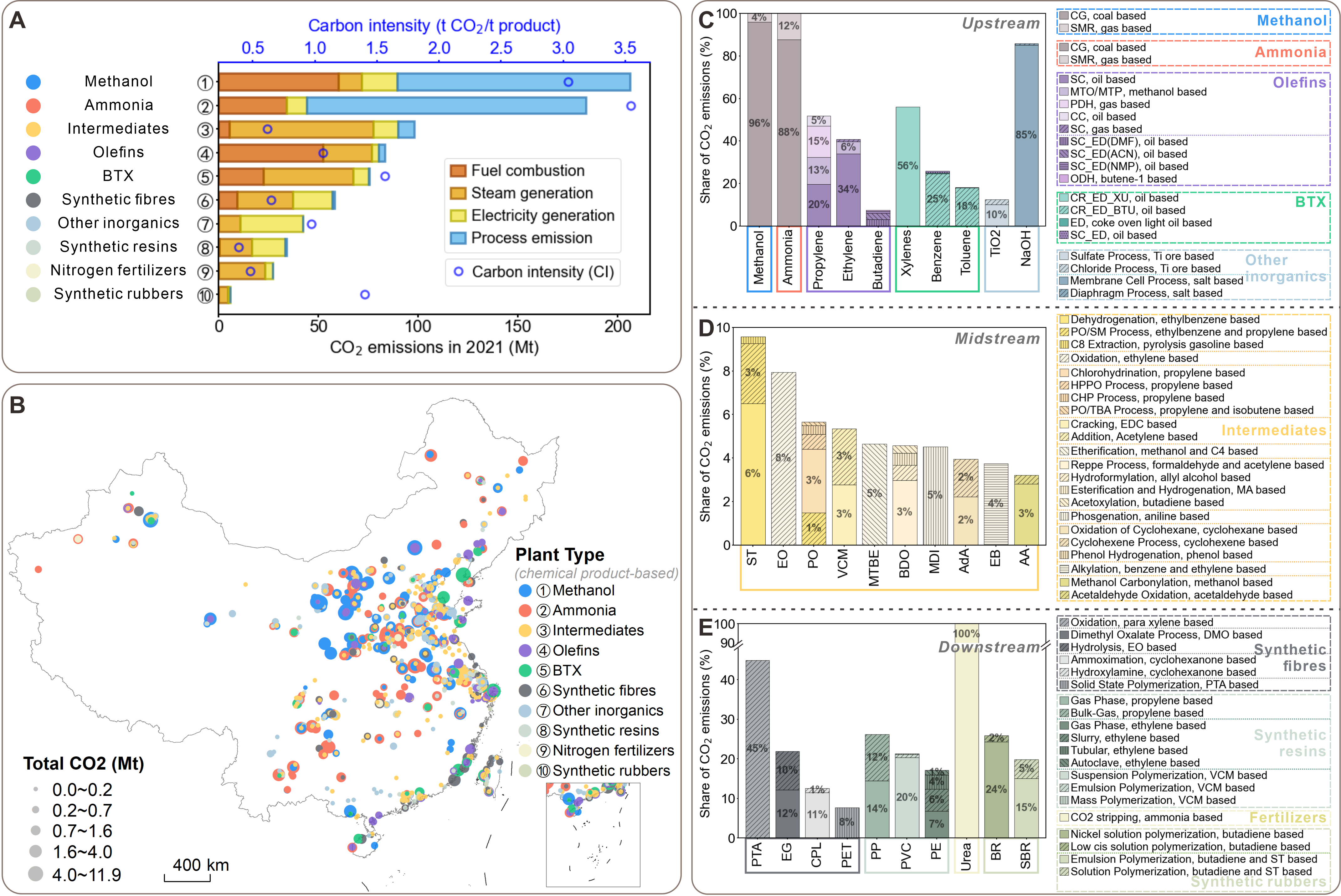
Figure 1. CO₂ emissions from China's petrochemical plants in 2021, shown by product type, CO₂ emission source, and production process.
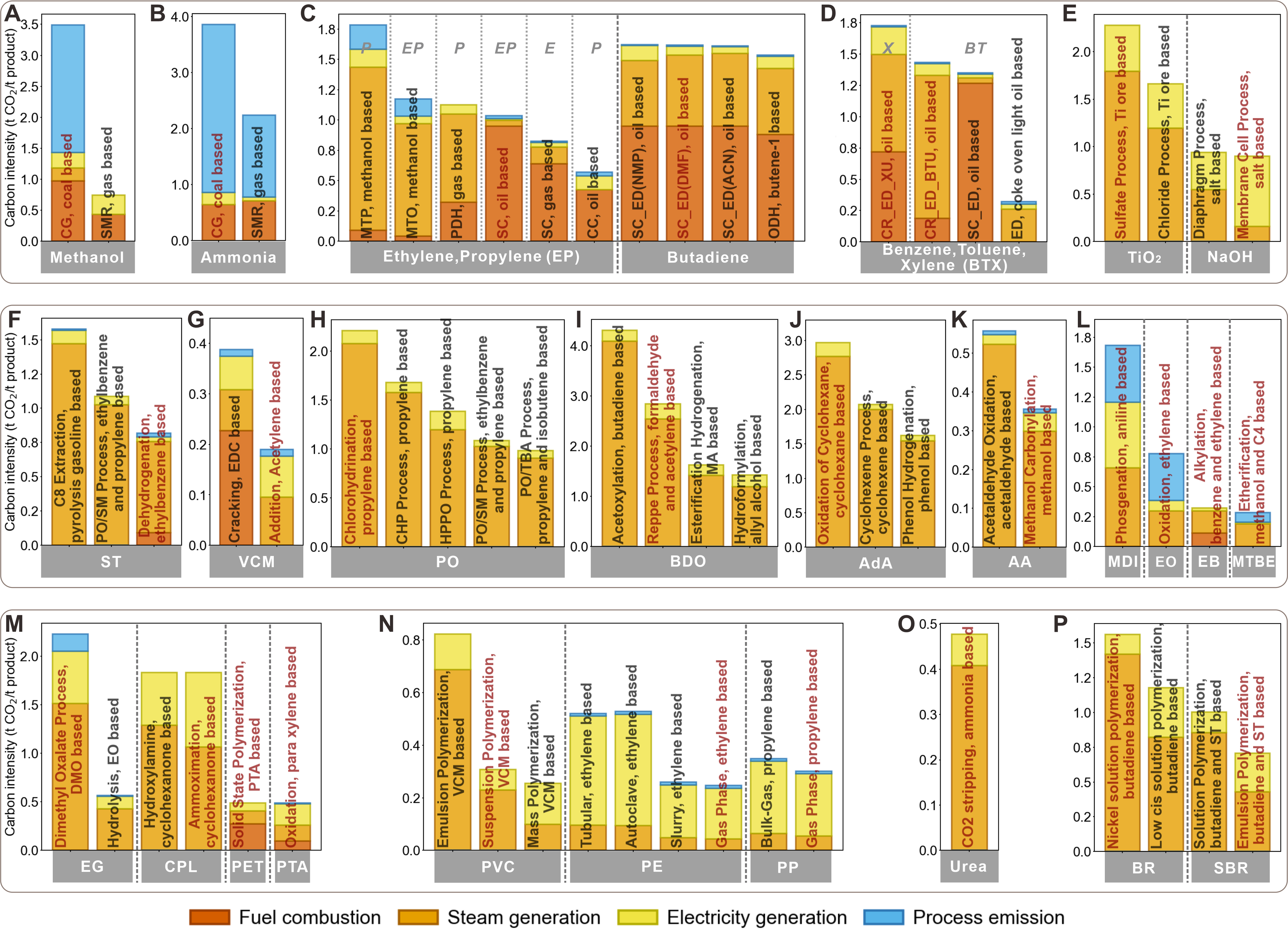
Figure 2. Carbon intensity of key products by detailed production processes and emission sources.
The results show that in 2021 total CO₂ emissions from China's petrochemical production amounted to approximately 814 million tonnes (Mt), with energy-related emissions accounting for 66.8% and process-related emissions for 33.2% (Figure 1). Emissions are highly concentrated in upstream basic chemical production, which contributes about 73% of the industry's total emissions, with methanol and ammonia alone accounting for approximately 48%. The analysis reveals that feedstock routes, reaction types, and energy structures significantly influence carbon intensity (Figure 2). For example, compared to gas-based routes, coal-based methanol and ammonia have carbon intensities that are about 2.8 and 1.6 t CO₂/t higher, respectively. In terms of dominant emission sources across processes, high-temperature reaction processes are dominated by fuel combustion emissions, some dehydrogenation processes are mainly affected by steam consumption, and products such as caustic soda, polypropylene, and polyethylene are primarily influenced by electricity use. This indicates that decarbonization of the petrochemical industry cannot rely on a single solution; instead, coordinated efforts in feedstock substitution, process optimization, and electrification should be pursued according to the dominant emission sources.
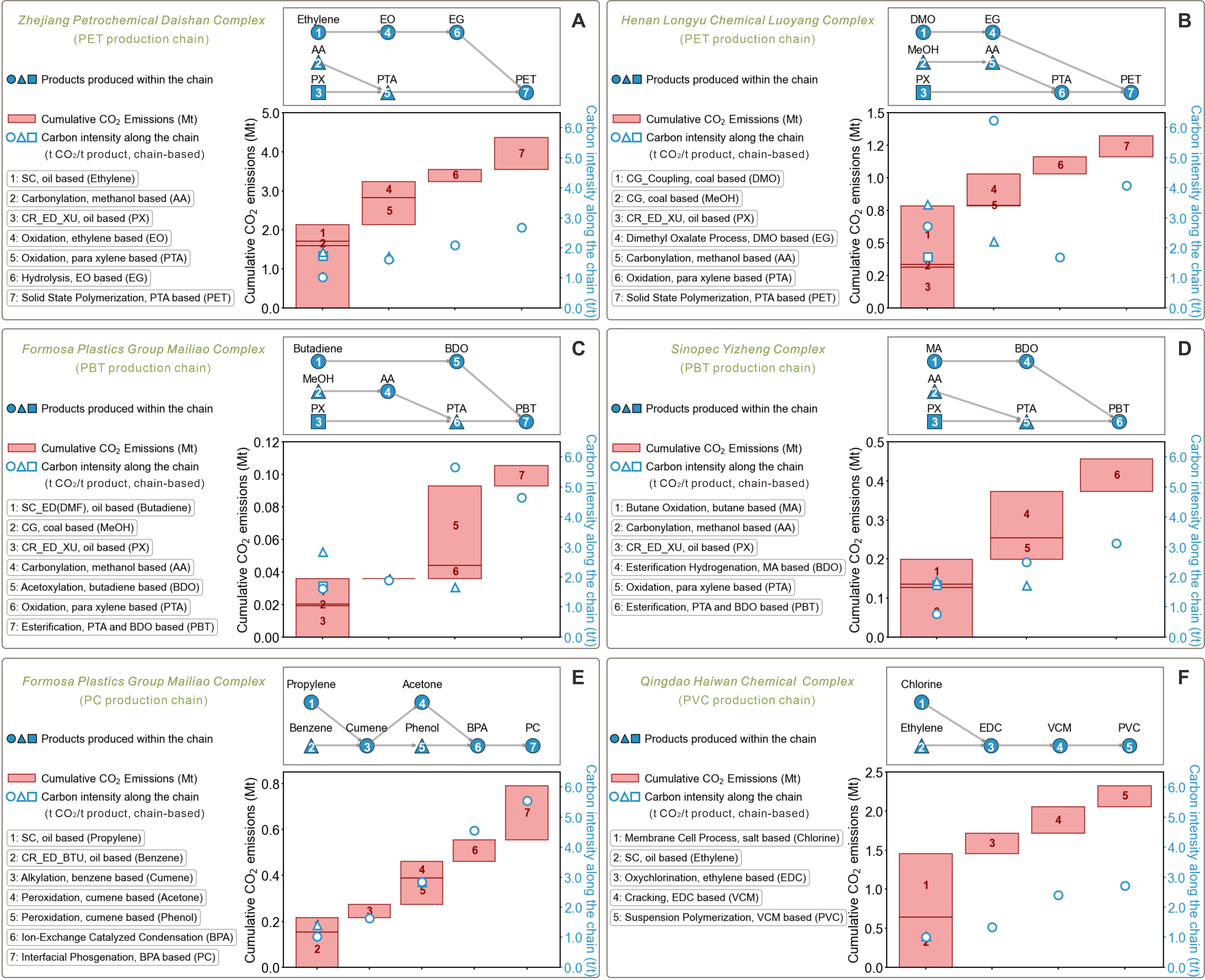
Figure 3. CO₂ emissions and carbon intensity across key production chains in typical petrochemical complexes.
The study traces emissions and cumulative carbon intensity along production chains within typical petrochemical complexes, revealing substantial emission differences for the same final product due to different upstream feedstock configurations and intermediate conversion routes (Figure 3). For example, the production chains of polymer products such as PET, PBT, PC, and PVC show markedly varying carbon intensities: the PC chain reaches about 5.1 t CO₂/t product, while the PVC chain reaches about 2.7 t CO₂/t product. The same product chain also exhibits significant differences across complexes. In the PET chain, the coal-based dimethyl oxalate (DMO) route has about 1.5 times the carbon intensity of the oil-based ethylene route; in the PBT chain, the oil-based butadiene route has about 1.5 times the carbon intensity of the gas-based maleic anhydride route. This demonstrates that industry emissions are shaped not only by individual processes or products but also by the combined effects of production networks and upstream-downstream relationships within complexes.
The relevant findings, titled "China's petrochemical plants' CO₂ emissions and high-impact contributors for carbon-neutrality production," were published in Science Advances. Chen Xiujing, a Class 2024 doctoral student from the Department of Earth System Science (DESS), Tsinghua University, is the first author; Lecturer Lei Tianyang from University College London and Professor Guan Dabo from Tsinghua University are the corresponding authors. The research was supported by the International Science Program on Carbon Neutrality and Energy System Transformation (CNEST), the Innovative Research Group Project of National Natural Science Foundation of China (NSFC), and other grants.
Full-text link:
https://www.science.org/doi/10.1126/sciadv.adx7784
Written by Chen Xiujing and Guan Dabo
Edited by Wang Jiayin
Reviewed by Zhang Qiang



 Picture News
 Hot News