Tropospheric winds form a cornerstone of the Earth's weather and climate system, directly driving global energy balance and moisture transport, and influencing the evolution of extreme weather events. However, due to the spatial and temporal sparseness of upper-air observations, long-term changes in tropospheric wind speed remain substantially uncertain, posing challenges for accurately assessing the response of atmospheric circulation to global warming.
To address this scientific challenge, Academician Chen Deliang’s Research Group from the Department of Earth System Science (DESS), Tsinghua University, has conducted an in-depth analysis of wind speeds at six standard pressure levels (850–200 hPa) in the troposphere using the Integrated Global Radiosonde Archive (IGRA). The study reveals that over the past four decades (1979–2019), global upper-tropospheric wind speeds have exhibited a significant increasing trend (Figure 1). At upper levels (200–300 hPa), clear signals of wind speed enhancement are observed over most global land areas, except Australia, with particularly pronounced increases over North America and jet stream exit regions. In contrast, wind speed trends in the lower troposphere appear weaker and more spatially heterogeneous. This vertical asymmetry—stronger wind speed changes aloft than at low levels—reflects the complex coupling between large-scale temperature gradient adjustments and regional circulation responses under global warming.
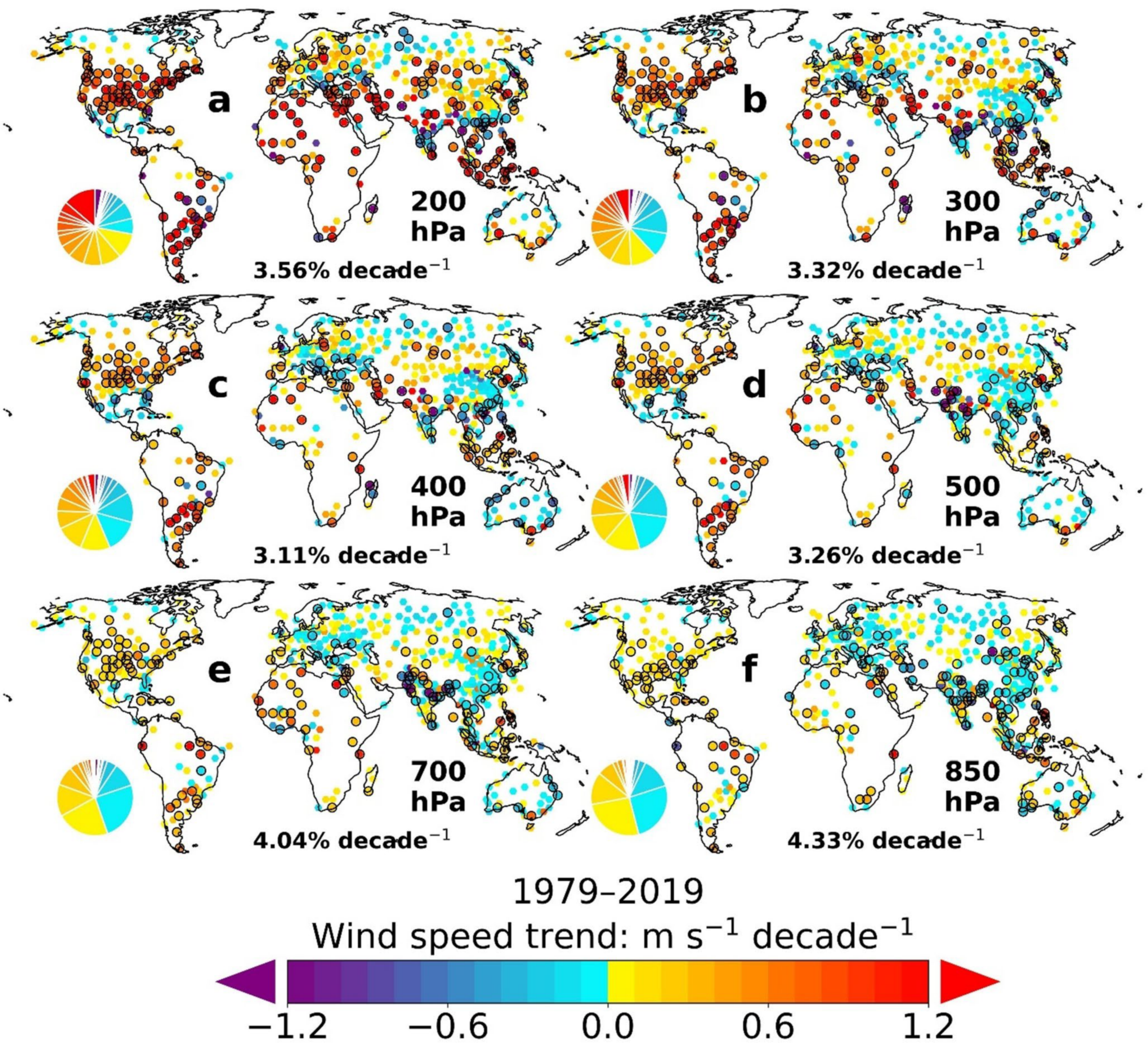
Figure 1 Long-term trends of upper-air wind speed at different pressure levels
Reanalysis datasets have become indispensable tools in climate research, yet their accuracy in capturing long-term wind speed trends still requires rigorous evaluation. The Research Group systematically compared the consistency between six mainstream global reanalysis products (CRA-40, ERA5, JRA55, NCEP1, NCEP2, and NOAA-V3) and radiosonde observations. The results show that while reanalyses generally capture the mean state and interannual variability of wind speed, they exhibit considerable discrepancies in long-term trends—particularly at upper levels—compared to observations. Most reanalysis products underestimate the magnitude of upper-level wind speed intensification, and in some regions even show opposite trend directions. Among the datasets, CRA-40 and ERA5 demonstrate relatively closer agreement with radiosonde trends, though notable regional biases remain in data-sparse areas. These uncertainties primarily stem from changes in observing systems, differences in data assimilation strategies, and limitations in representing physical processes such as orographic effects.
This study not only deepens our understanding of the dynamic evolution of global atmospheric circulation but also provides important references for wind energy resource assessment, aviation weather safety, and climate model improvement. The study indicates that the significant intensification of upper-level wind speeds may act as an early warning signal for wind power potential. In the future, it is essential to further strengthen the global radiosonde observation network and optimize assimilation techniques to enhance the credibility of climate reconstruction and prediction.
The relevant research findings, titled "Global intensification of mean tropospheric winds from IGRA radiosonde and reanalyses," were published online in Climate Dynamics on March 5, 2026. Academician Chen Deliang from the Department of Earth System Science (DESS), Tsinghua University, is the corresponding author, and Engineer Yu Yue from the Nanjing Meteorological Bureau is the first author. The research was supported by Tsinghua University, the Swedish Research Council, and the Swedish Foundation for International Cooperation in Research and Higher Education (STINT).
Full-text link: https://link.springer.com/article/10.1007/s00382-025-08005-y
Written by
Edited by Wang Jiayin
Reviewed by Zhang Qiang



 Picture News
 Hot News