Nighttime light (NTL) remote sensing is a vital proxy for quantifying the intensity and spatial distribution of human activities. However, early DMSP-OLS data suffer from saturation and blurring effects, while high-quality NPP-VIIRS data are only available from 2012 onward, lacking direct comparability between the two systems, which limits long-term time-series studies. Existing cross-sensor calibration products often face two major shortcomings: underestimation of light intensity and omission of structural details (e.g., road networks and rural settlements).
To address the above problem, Professor Xu Bing’s Research Group from the Department of Earth System Science (DESS), Tsinghua University, proposes a novel two-stage deep learning framework that integrates a Hierarchical Fusion Decoder (HFD) and a Dual Feature Refiner (DFR). The framework leverages high-resolution impervious surface data as guidance to refine fine-grained structural details, producing a nighttime light dataset at 500 m resolution. At the pixel scale, the EVAL dataset demonstrates excellent performance, achieving an R⟡ of 0.8088 and an RMSE as low as 0.9965. At the city scale, an aggregated analysis based on 2,891 county-level administrative units across China shows an R⟡ as high as 0.975, significantly outperforming state-of-art products. The resulting EVAL dataset not only resolves the saturation issues inherent in DMSP-OLS data but also effectively recovers intra-urban textures and road network details.
The above findings were published in Scientific Data, a data journal under Nature, titled "An Extended VIIRS-like Artificial Nighttime Light Data Reconstruction (1986–2024)." Doctoral student Tian Yihe from the Department of Earth System Science (DESS), Tsinghua University, is the first author, and Professor Xu Bing is the corresponding author. Co-authors include undergraduate student Zheng Junwen (Kwan Man Cheng) from the College of Letters and Science, University of Wisconsin–Madison (co-first author), doctoral student Zhang Zhengbo from the Institute of Automation, Chinese Academy of Sciences, Dr. Zhang Tao (Assistant Research Fellow) from the Department of Tsinghua DESS, doctoral student Feng Junning from Tsinghua DESS, Dr. Ren Zhehao (alumnus of Tsinghua DESS), Professor Li Suju from the National Disaster Reduction Center of the Ministry of Emergency Management, and Professor Yan Dongmei from the Aerospace Information Research Institute, Chinese Academy of Sciences. This study was supported by the National Key Research and Development Program of China (Grant No. 2022YFB3903703). The dataset covers the entire territory of China with a time span of 39 years (1986–2024), representing the longest time series and highest accuracy VIIRS-like NTL data product known to date, providing high-quality long-term data support for urbanization monitoring, socioeconomic development assessment, carbon emission estimation, and the evaluation of the United Nations Sustainable Development Goals (SDGs).
The National Tibetan Plateau Data Center (TPDC, http://data.tpdc.ac.cn), serving as the data repository for this paper, has publicly released the "Extended VIIRS-like Artificial Nighttime Light Dataset of China (1986–2024)" at https://doi.org/10.11888/HumanNat.tpdc.302930, which is publicly accessible.
 �
�
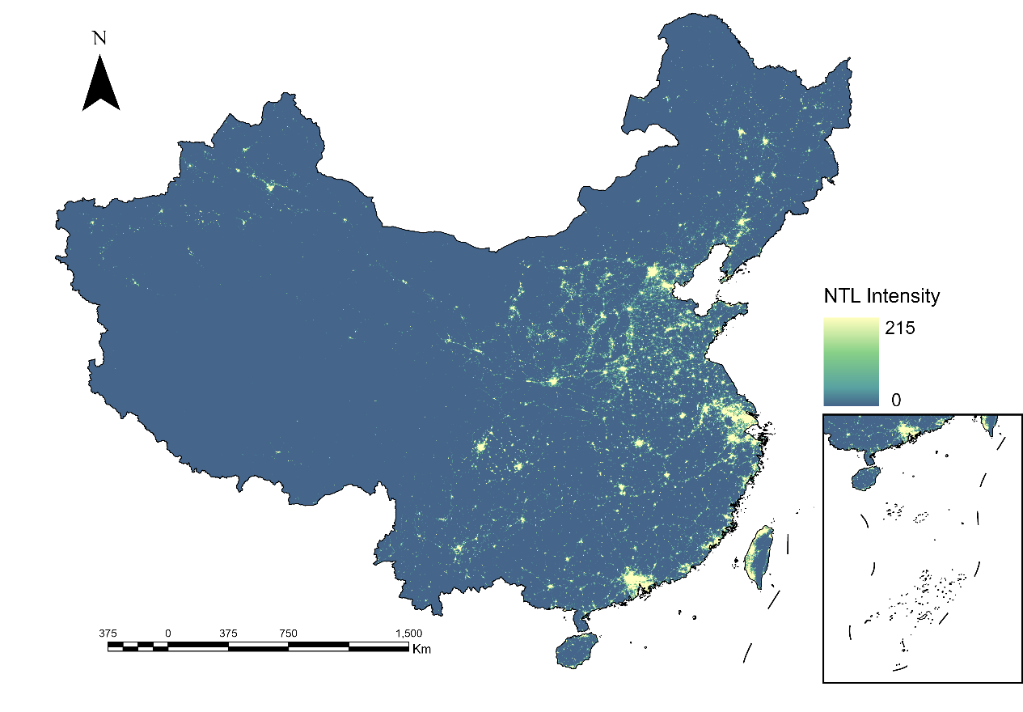
Figure 1. Distribution of nighttime light intensity across China from the EVAL dataset for the year 2012.
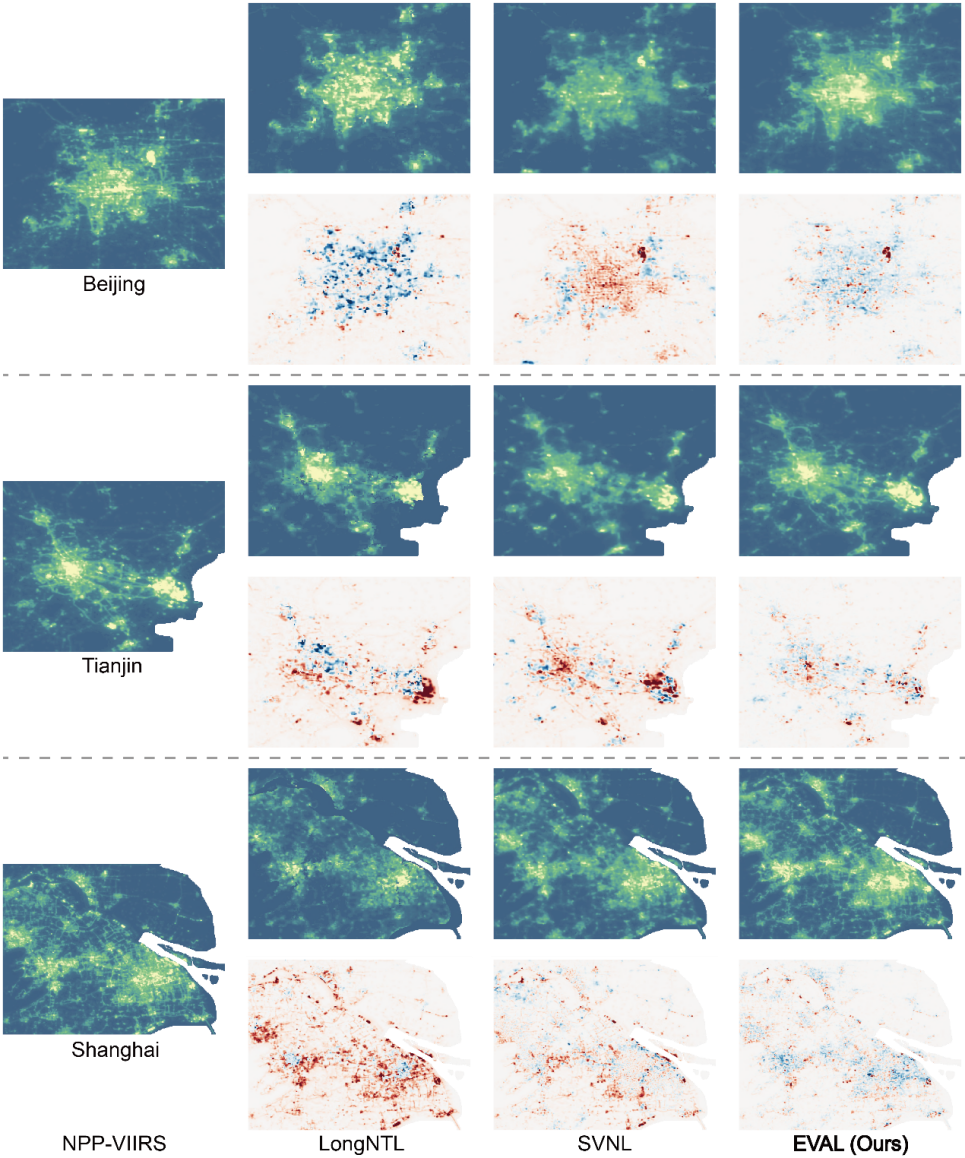
Figure 2. Comparison of EVAL data with existing products in addressing light intensity underestimation in the core areas of three major urban agglomerations.
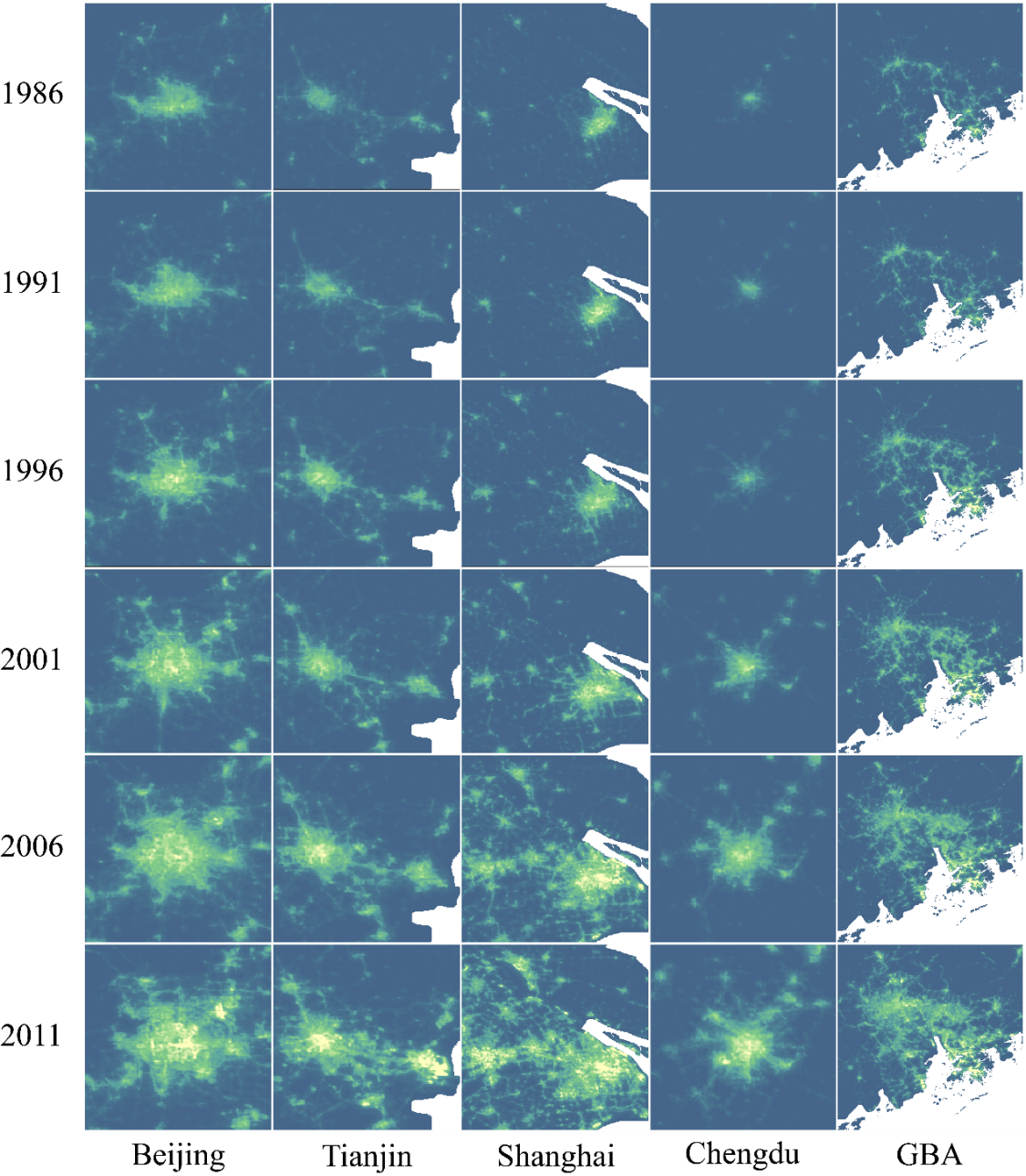
Figure 3. Spatiotemporal evolution of nighttime lights in five typical urban agglomerations in China from 1986 to 2011.
Paper Information: Tian, Yihe, Kwan Man Cheng, Zhengbo Zhang, Tao Zhang, Junning Feng, Zhehao Ren, Suju Li, Dongmei Yan, and Bing Xu. "An Extended VIIRS-like Artificial Nighttime Light Data Reconstruction (1986–2024)." Scientific Data (2026).
Full-text link:
https://doi.org/10.1038/s41597-026-06549-0
Data Information: Tian Yihe, Kwan Man Cheng, Zhengbo Zhang, Tao Zhang, Suju Li, Dongmei Yan, and Bing Xu. (2025). Extended VIIRS-like Artificial Nighttime Light Dataset of China with Extended Time Series (1986–2024). National Tibetan Plateau Data Center.
https://doi.org/10.11888/HumanNat.tpdc.302930. https://cstr.cn/18406.11.HumanNat.tpdc.302930.
Data Link (Chinese):
https://data.tpdc.ac.cn/zh-hans/data/10.11888/HumanNat.tpdc.302930
Data Link (English):
https://data.tpdc.ac.cn/en/data/10.11888/HumanNat.tpdc.302930



 Picture News
 Hot News