Sea ice is a critical component of the climate system. The Marginal Ice Zone (MIZ), a key region for sea ice formation and decay, plays an indispensable role in the recent dramatic changes in Antarctic sea ice. Due to the harsh natural environment in the marginal ice zone, in-situ observations and datasets are extremely limited. Meanwhile, traditional remote sensing methods are not suitable for the complex conditions of the marginal ice zone, which greatly restricts the monitoring capability and scientific understanding of key processes in this region.
To address the difficulties and prominent challenges in marginal ice zone observations, the research group led by Associate Professor Xu Shiming from the Department of Earth System Science (DESS), Tsinghua University, has developed a novel retrieval method and dataset for the marginal ice zone based on satellite ocean altimetry in recent years. A series of wave-in-ice detection algorithms have been proposed for different types of satellite altimeters, including conventional pulse-limited radar altimeters and delay-Doppler radar altimeters. Based on these algorithms, a climatic dataset of the marginal ice zone in the Atlantic sector of the Arctic has been constructed using CryoSat-2 satellite observations (Zhu et al., ESSD 2024).
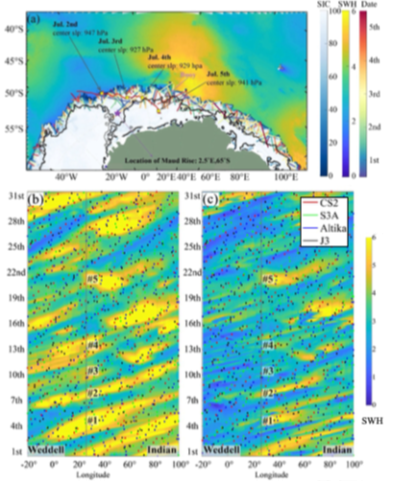
Figure 1 Wind waves generated by intense storm events can propagate long distances within sea ice.
Given the vast extent of the Southern Ocean marginal ice zone, the coverage by a single satellite is insufficient. Through spatiotemporal fusion of four altimetry satellites (Fig. 1b/c), systematic coverage of cyclones and weather-scale processes in the marginal ice zone has been achieved. Observations reveal an intense storm event and its wave impacts on the marginal ice zone in the Weddell Sea–Indian Ocean sector of the Southern Ocean in July 2019 (Figure 1). Early that month, an explosive cyclone formed in this region, generating large waves exceeding 8 meters in height. These waves then entered the sea ice at 59°S, 10°E in the eastern Weddell Sea and propagated southward for more than 600 km.
The novel retrieval methods and datasets for the marginal ice zone further reveal the complex wave–sea ice interactions in the Southern Ocean and propose a sea ice thickness estimation method based on the marginal ice zone, providing new insights for studies on the sea ice mass balance of the Southern Ocean. This research reveals the significant impacts of intense cyclones on the Southern Ocean and sea ice, offering new approaches and data support for studies on polar ocean–sea ice interactions.
The findings were published in Geophysical Research Letters under the title “Detailed Monitoring of Antarctic Marginal Ice Zones by Satellite Radar Altimeters – A Study of the Weddell Sea/Indian Sector in July 2017”.
This work was supported by the National Natural Science Foundation of China and the National Key R&D Program of China. Associate Professor Xu Shiming from Tsinghua DESS is the first author and corresponding author of the paper. Collaborators include Dr. Zhu Weixin and Dr. Lu Zhou (co-corresponding authors), graduates of Tsinghua DESS; Liu Siqi, a PhD candidate of the 2023 cohort; Prof. Cheng Xiaohui from the Department of Civil Engineering, Tsinghua University; Prof. Alexander D. Fraser from the University of Tasmania, Australia; Dr. Clare Eayrs from the Korea Polar Research Institute; and Prof. Marcello Vichi from the University of Cape Town, South Africa, as well as other international collaborators.
Full text links:
Shiming Xu*, Weixin Zhu, Lu Zhou*, Siqi Liu, Alex D. Fraser, Xiaohui Cheng, Clare Eayrs, and Marcello Vichi. Detailed Monitoring of Antarctic Marginal Ice Zones by Satellite Radar Altimeters – A Study of the Weddell Sea/Indian Sector in July, 2017, Geophysical Research Letters, 52, e2025GL115782, doi:10.1029/2025GL115782.
Weixin Zhu, Siqi Liu, Shiming Xu*, and Lu Zhou. 2024. A 12-Year Climate Record of Wintertime Wave-Affected Marginal Ice Zones in the Atlantic Arctic based on CryoSat-2, Earth System Science Data, 16, 2917–2940, doi:10.5194/essd-16-2917-2024.
Written by



 Picture News
 Hot News