Species interactions form the core of ecosystem functions and represent a key process shaping biodiversity patterns. Research on the interactions between frugivorous birds and fruiting trees in natural ecosystems is an important approach to understanding the mechanisms of cross-trophic species interactions and their ecological impacts. Compared with natural ecosystems, urban areas exhibit distinct differences in habitat structure, disturbance types and plant species composition. Driven by urbanization-induced biotic homogenization, a critical question arises: whether the insights into frugivorous bird-fruiting tree interactions derived from natural systems remain valid in urban environments.
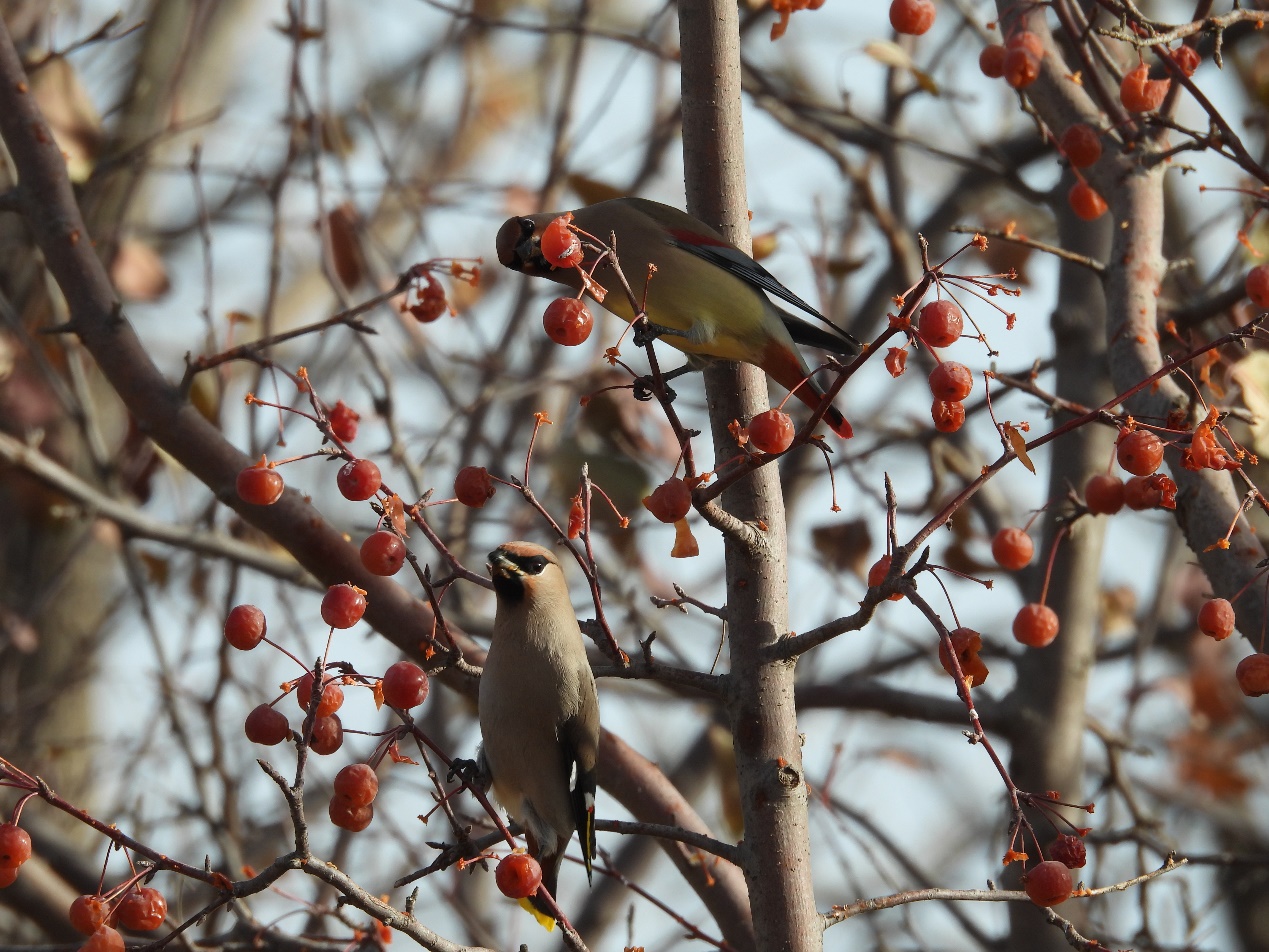
Figure 1 Bombycilla japonica and Bombycilla garrulus foraging on the fruits of Malus sp. at Xinglong Park, Chaoyang District, Beijing, December 2023. Photo by Liu Xinyi.
To address this question, the research group led by Professor Yang Jun from the Department of Earth System Science (DESS) at Tsinghua University has conducted continuous research on the interactions between urban frugivorous birds and fruiting trees over the past four years, integrating field surveys, automated monitoring and citizen science data. The findings confirm a significant positive correlation between the species richness of frugivorous birds and that of fruiting trees at the whole-city scale, with seasonal variations associated with fruit phenology. This indicates that fruiting tree resources remain a key ecological factor shaping the distribution patterns of urban frugivorous birds. Meanwhile, a small number of widely distributed tree species with high fruit yield are frequently utilized by various bird species across different urban sites, playing a pivotal supporting role in the overall species interaction network.
The team further focused on the spatial heterogeneity of the structure of fruiting tree-bird interaction networks within urban areas. Results show that urban interaction networks are generally simplified and dominated by a few generalist species, yet significant structural differences exist across different sites. Such differences are mainly reflected in the turnover and compositional changes of bird and fruiting tree species, with network modularity emerging as a key metric distinguishing interaction structures at different locations. In-depth analysis reveals that vegetation coverage and fruiting tree diversity at different sites are significantly correlated with variations in network structure. Even within a single city, fruiting tree-bird interactions exhibit distinct spatial heterogeneity, implying that it is practically feasible to maintain more complex and diverse interaction networks in urban areas through habitat improvement.
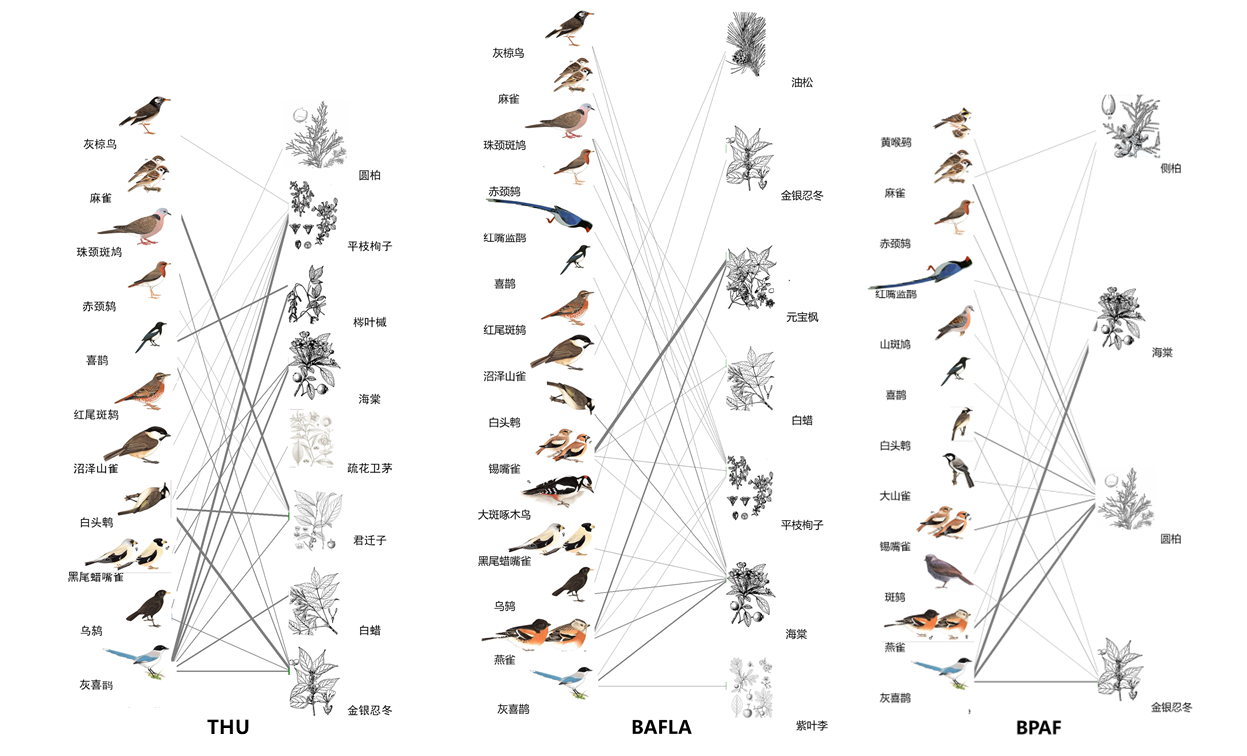
Figure 2 Fruiting tree-bird foraging interactions monitored by arboreal infrared cameras at three study sites: Tsinghua University (THU); Beijing Academy of Forestry and Landscape Architecture (BAFLA); Beijing Plain Area Forest (BPAF).
To explore the temporal dynamics of interactions between urban frugivorous birds and fruiting trees, the team conducted continuous observations of fruiting tree-bird foraging behaviors in urban areas using arboreal infrared camera trapping. Results demonstrate significant variations in frugivory across seasonal, monthly and diurnal temporal scales. Large-scale ecological processes such as fruit phenology and bird migration are significantly associated with the seasonal changes in frugivorous behaviors, while local conditions including fruiting tree diversity and human activities are closely linked to monthly variations and diurnal foraging rhythms. The study also finds that observations with high temporal resolution are indispensable for understanding frugivorous behaviors in urban environments.
The above research indicates that the quantity, species composition and phenological characteristics of urban fruiting tree resources are closely correlated with the distribution patterns, species composition and interaction modes of frugivorous birds. Even in urban ecosystems under the influence of biotic homogenization, cross-trophic interactions between frugivorous birds and fruiting trees are altered and tend to be simplified, yet they still retain a certain degree of diversity that modulates urban ecosystem functions. These findings also provide a scientific reference for maintaining diverse and stable bird-tree interactions in urban areas through the rational configuration of fruiting tree resources. For instance, priority should be given to the conservation and rational deployment of key fruiting tree species with high utilization frequency by various frugivorous birds to ensure the stable supply of important foraging resources; the continuity of fruiting tree resource supply in urban green spaces across time should be enhanced by combining fruiting tree configuration with vegetation structure optimization, thereby improving the capacity of urban ecosystems to support frugivorous birds.
These research findings have recently been published in a series of academic papers. Liu Xinyi, a PhD candidate from the Department of Earth System Science at Tsinghua University, is the first author, and Professor Yang Jun is the corresponding author. Co-authors include Yang Xudong and Zhou Jing, PhD candidates from the Department of Earth System Science at Tsinghua University, Li Xinyu, Researcher from the Beijing Academy of Forestry and Landscape Architecture, and Guo Zhitao from Beijing Rujing Ecological Landscaping Co., Ltd. The research was supported by the National Natural Science Foundation of China under the project entitled "Cascade Effects of Urbanization-Driven Biotic Homogenization: A Case Study of Trees and Birds" (Grant No. 32171542).
Paper Links:
Liu X, Yang X, Li X, Yang J (2025) Exploring the relationship between frugivorous birds and fruiting trees in urban parks using citizen science data. Urban Ecosystems, 28: 51. https://doi.org/10.1007/s11252-024-01625-y.
Liu X, Yang X, Zhou J, Li X, Guo Z, Yang J (2025) Patterns of avian frugivory in Beijing’s urban forest across multiple temporal scales. Ecology and Evolution, 15: e72699. https://doi.org/10.1002/ece3.72699.
Liu X, Yang X, Zhou J, Li X, Yang J (2025) Intra-urban variability in frugivorous bird and fruiting tree interaction networks. Ecological Frontiers, https://doi.org/10.1016/j.ecofro.2025.12.010.
Written by Liu Xinyi
Edited by Wang Jiayin
Reviewed by Geng Rui



 Picture News
 Hot News