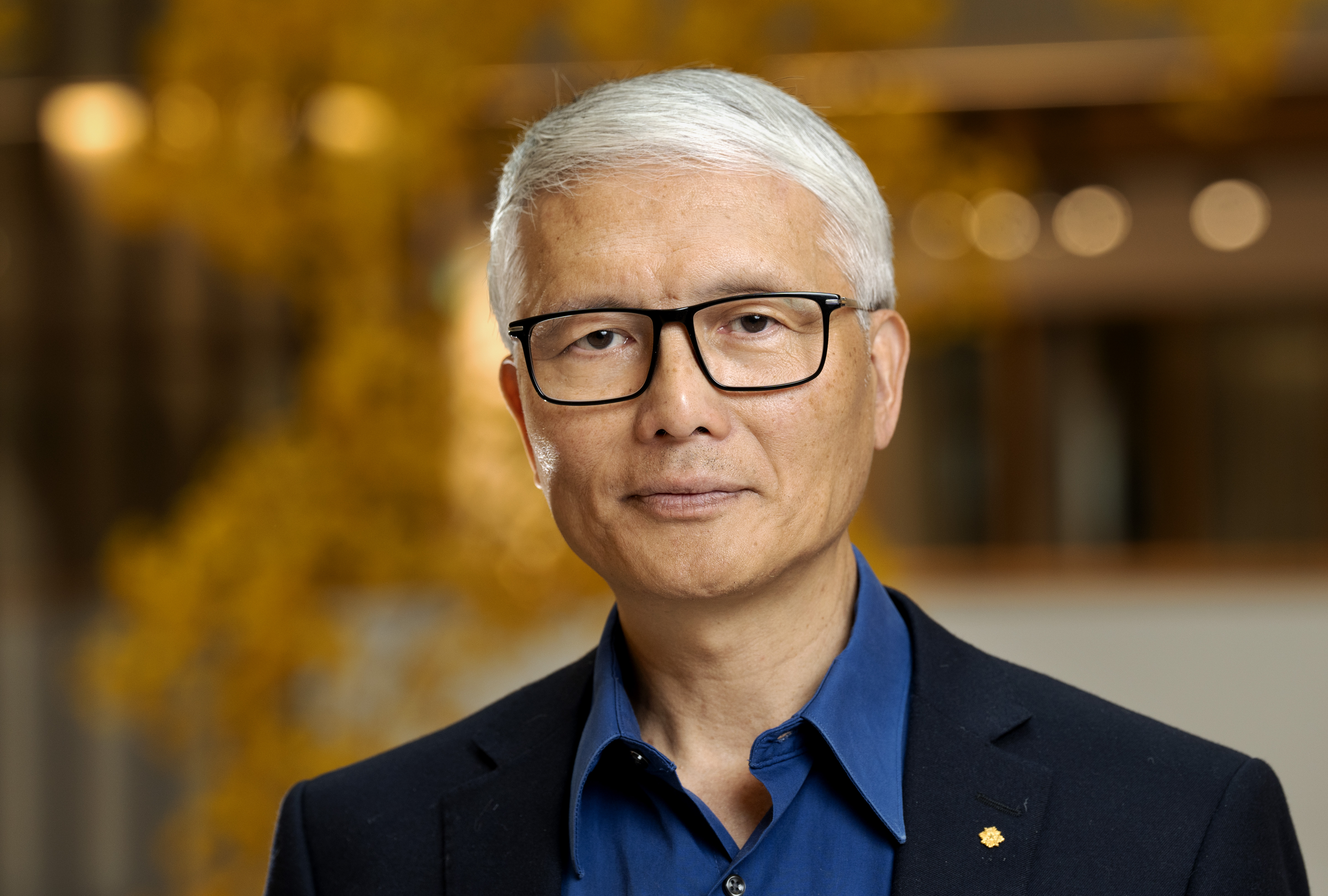
On September 18, a collaborative study by Professor Zhang Qiang’s team from the Department of Earth System Science (DESS), Tsinghua University, and Associate Professor Zheng Bo’s team from the Institute of Environment and Ecology, Tsinghua Shenzhen International Graduate School, titled “Global warming amplifies wildfire health burden and reshapes inequality”, was published online as an “Accelerated Article Preview (AAP)” in Nature. The study uncovers the future health and climate impacts of global wildfire emissions amid climate change, and examines the potential effects and key insights brought about by the “mysterious forces” behind global warming. This marks another significant achievement for the team in the field of global wildfire emissions and their climate-environmental effects, following their related research published in Science in 2023 and in Nature on the 10th of this month.
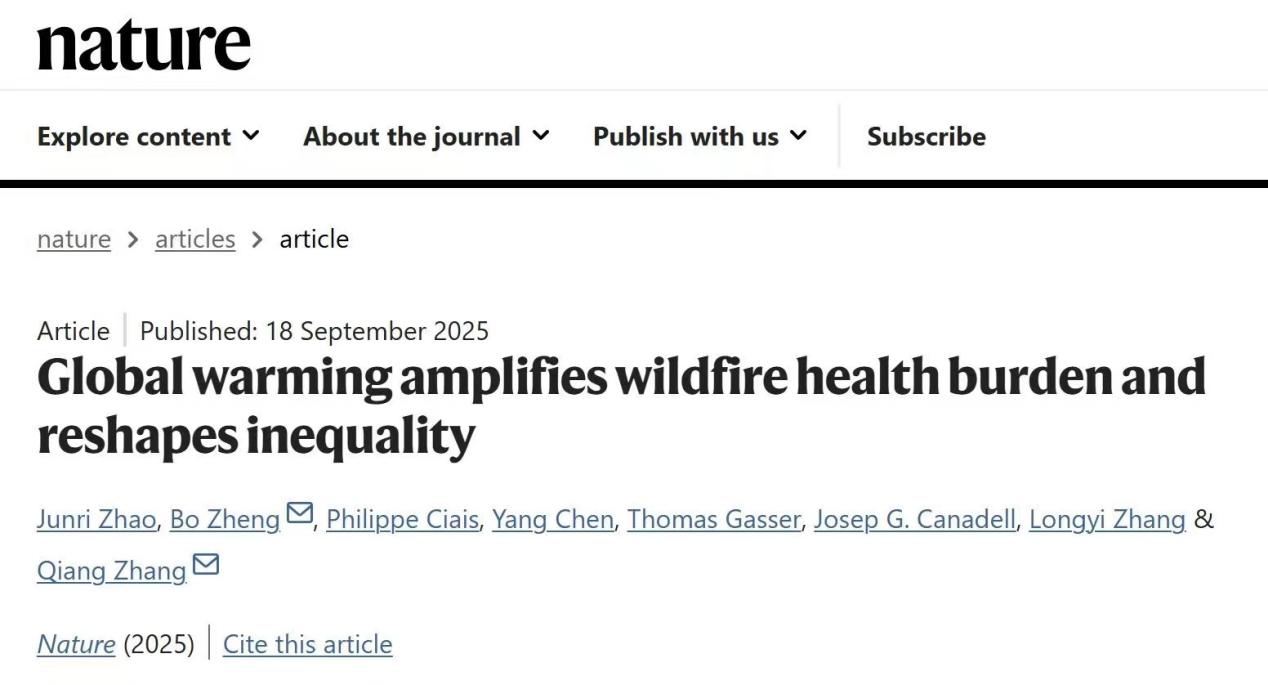
Screenshot of the Nature Article
Wildfires—defined as forest, grassland, and shrub fires occurring under natural conditions—are key disturbance factors in the Earth’s environment. These events emit substantial amounts of greenhouse gases and atmospheric pollutants, posing severe threats to both climate stability and public health. Against the backdrop of climate change, the frequency, intensity, and spatiotemporal scope of global wildfires are all on the rise. Fine particulate matter (PM₂.₅) in wildfire smoke is highly toxic, and there is a significant link between exposure to wildfire pollution and the risk of premature death in human populations. However, current scientific understanding of the future trends, health impacts, and climate effects of global wildfire emissions remains highly uncertain, which has become a major constraint on wildfire risk management.
To address this critical scientific challenge, Professor Zhang Qiang’s team and Associate Professor Zheng Bo’s team, in collaboration with domestic and international research partners, developed a wildfire emission prediction technology based on machine learning models. This work builds on a previously established methodological framework for assessing global wildfire emissions and their environmental health effects. The team integrated multi-source remote sensing observations, reanalysis data, and Earth system model simulations, and introduced spatiotemporal dynamic drivers to characterize the multi-dimensional feedback mechanisms governing wildfire occurrence and development. This enabled the simulation and attribution analysis of wildfire activity and emissions under different future climate scenarios. Further integrating atmospheric chemical transport models and health impact models, the study revealed the future health and climate effects of global wildfire emissions in the context of climate change.
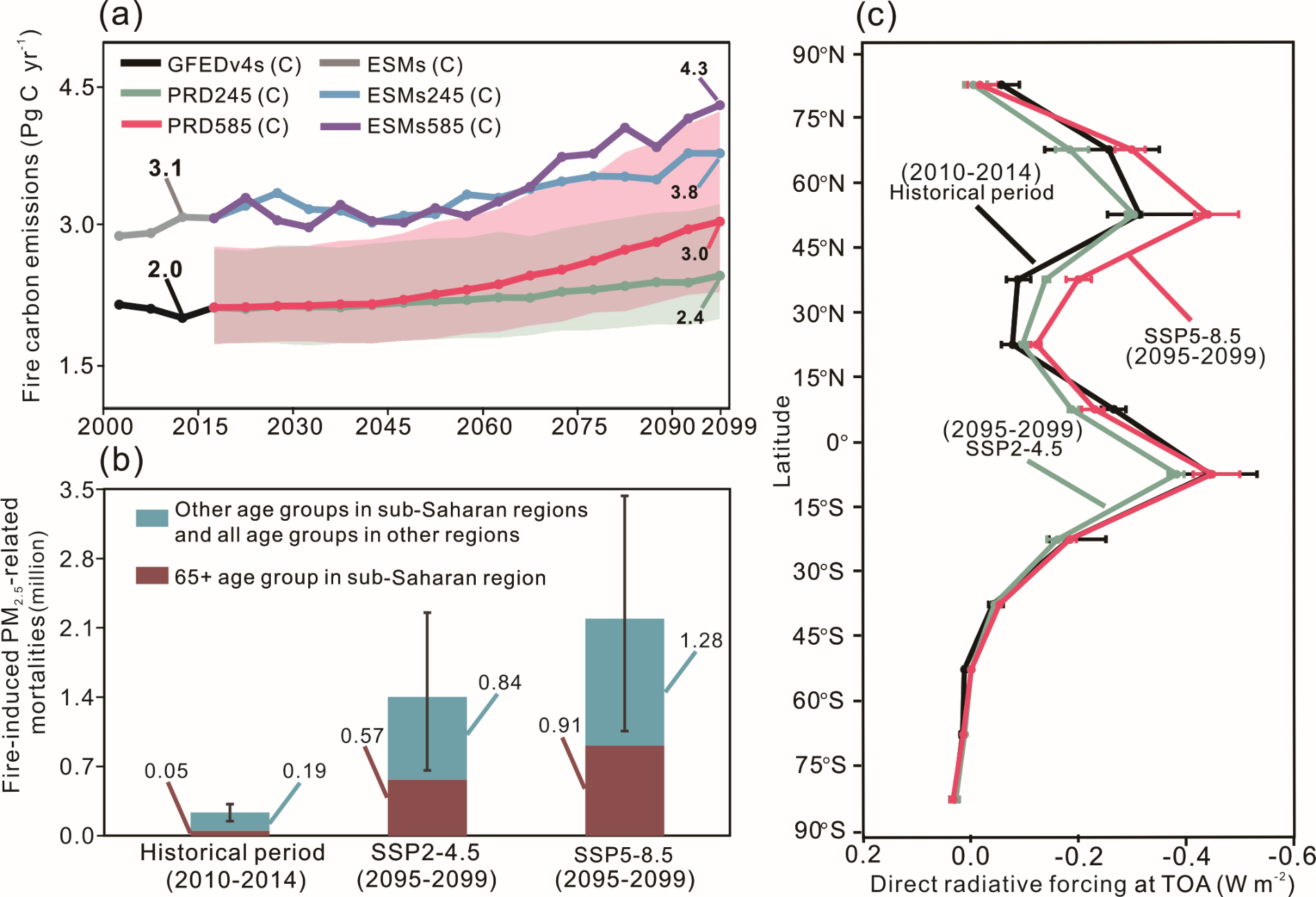
Figure 1 Historical changes and future projections of wildfire emissions, and their impacts on PM₂.₅-related health effects and direct radiative forcing
The study found that as climate warming and drought intensify, global wildfire activity will increase significantly in the future. Under the intermediate emission scenario (SSP2-4.5), global wildfire carbon emissions are projected to rise by approximately 23% by the end of this century compared to current levels. Additionally, around 1.4 million premature deaths worldwide each year could be attributed to exposure to PM₂.₅ from wildfire smoke—six times the current figure (Figure 1). Global warming not only exacerbates the health risks of wildfire pollution but also alters its distribution across different regions and economies. Less developed regions will continue to bear a disproportionate share of the global future wildfire health burden. However, under the high-warming scenario (SSP5-8.5), wildfire activity in developed regions will surge in the future. Coupled with the trend of population aging, their share of global wildfire health risks will increase markedly, reshaping the regionally differentiated pattern of health risks from wildfire PM₂.₅ exposure (Figure 2).
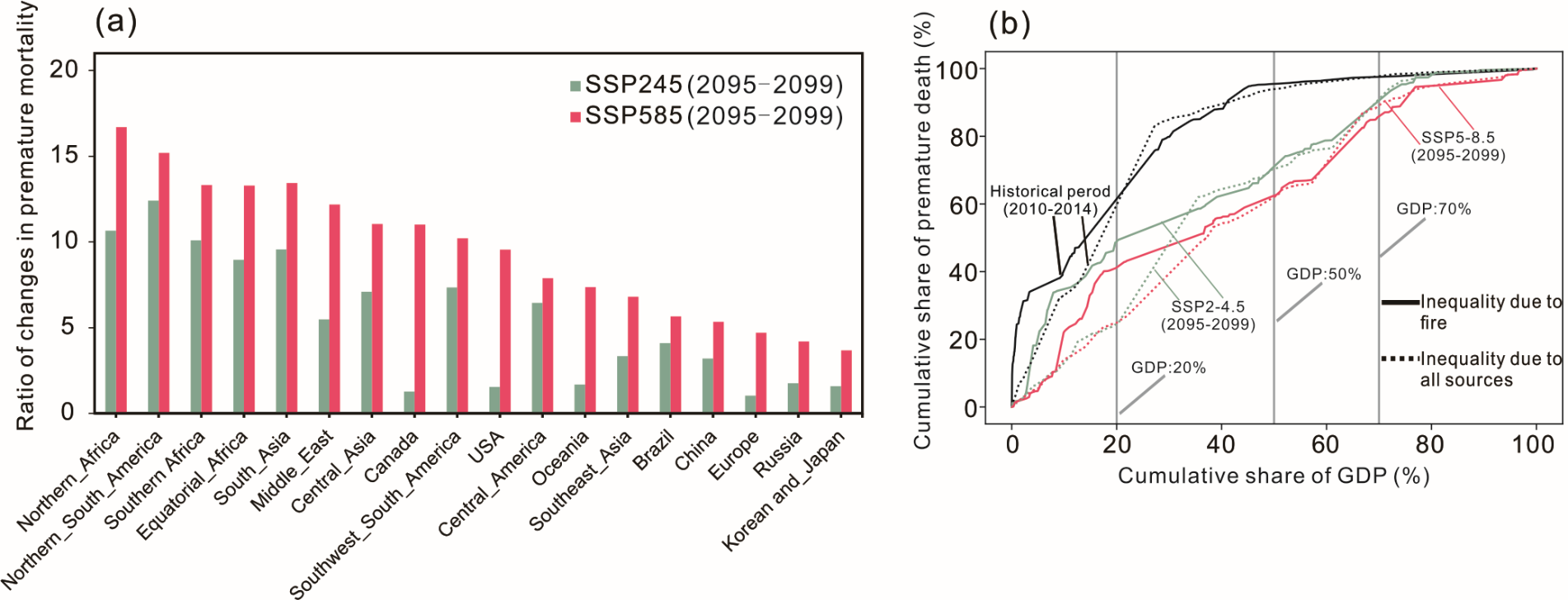
Figure 2 PM₂.₅-related health effects of wildfires in different regions and their global distribution patterns (comparison between historical and future scenarios)
The study further revealed that while increased future wildfire emissions will enhance the cooling effect of wildfire aerosols’ direct radiative forcing on a global scale, this cooling effect will weaken by approximately 0.06 W/m⟡ in the Arctic region by the end of this century (under the SSP2-4.5 scenario), potentially accelerating future polar warming (Figure 1). Notably, although the cooling effect of wildfire aerosols can mitigate local warming to some extent, greenhouse gas emissions from wildfires and the damage to forest carbon sink functions will both exacerbate climate change. The multi-dimensional impacts and feedback mechanisms between wildfires and climate change underscore the complexity and urgency of wildfire management.
This study expands the application of artificial intelligence technology in assessing the climate-environmental effects of wildfires. The global assessment framework for wildfire emissions and their climate-environmental effects developed by the team provides a scientific tool for further related research. The team’s series of achievements in this field offer key scientific evidence for a deeper understanding of the complex interconnections between climate change, wildfire risks, and human health. They also inspire policymakers to fully consider wildfires as a critical risk factor when formulating strategies to address climate change and air pollution, strengthen monitoring, early warning, and emergency response capabilities, and promote cross-regional collaborative governance of wildfire pollution.
Entitled “Global warming amplifies wildfire health burden and reshapes inequality”, the study was published online as an “Accelerated Article Preview” in Nature. Following the team’s 2023 publication in Science— which analyzed changes in wildfire carbon emissions and their driving forces in mid-to-high latitude regions of the Northern Hemisphere—and their publication in Nature on the 10th of this month on the global impacts of long-range transport of extreme wildfire smoke, this work represents another major breakthrough in the field of global wildfire emissions and their climate-environmental effects.
Zhang Qiang and Zheng Bo serve as co-corresponding authors of the paper. Zhao Junri, a former postdoctoral fellow at Tsinghua Shenzhen International Graduate School (now Designated Assistant Professor at Nagoya University, Japan), is the first author. Co-authors include Philippe Ciais, a Foreign Member of the Chinese Academy of Sciences (CAS), Distinguished Visiting Professor at Tsinghua University, and researcher at the Laboratoire des Sciences du Climat et de l’Environnement (LSCE) in France; multiple collaborators from the University of California, Irvine (USA), the International Institute for Applied Systems Analysis (IIASA, Austria), and the Commonwealth Scientific and Industrial Research Organisation (CSIRO, Australia); as well as graduate students from Tsinghua Shenzhen International Graduate School. The research is supported by the National Natural Science Foundation of China, the “Carbon Neutrality and Energy System Transformation (CNEST)” program, and the Xplorer Prize from the New Cornerstone Science Foundation.
Paper Link:
https://www.nature.com/articles/s41586-025-09612-9
https://www.nature.com/articles/s41586-025-09612-9
Relevant achievements of the team in global wildfire emissions and climate-environmental effects:
https://www.nature.com/articles/s41586-025-09482-1
https://www.science.org/doi/10.1126/science.ade0805
Text/Photos by Zheng Bo
Edited by Wang Jiayin
Reviewed by Geng Rui



 Picture News
 Hot News