In September 2025, the Fifth World Congress of Biosphere Reserves (the 5th WCBR) was held in Hangzhou, China, where landmark outcomes such as the Hangzhou Strategic Action Plan and the Hangzhou Declaration were released. The World Network of Biosphere Reserves (WNBR) is the core vehicle of UNESCO's "Man and the Biosphere Programme" (MAB). As two significant international agendas, the synergy between the MAB and the Kunming-Montreal Global Biodiversity Framework (KMGBF) is of great significance for promoting global biodiversity conservation and sustainable development. At this important historical juncture, Associate Professor Yu Le from the Department of Earth System Science (DESS) at Tsinghua University, in collaboration with the Research Group of Professor Ma Keping from Northeast Forestry University, conducted the first global-scale systematic assessment of the potential of the WNBR to advance the implementation of the KMGBF.
The research results show that the overall habitat quality of biosphere reserves has remained relatively stable, with average levels not lower than those of traditional protected areas. When BRs were integrated with PAs and OECMs, conservation coverage for terrestrial areas increased from 16.57% to 19.65%. In Latin America and the Caribbean, coverage would leap from 24.34% to 35.72%, significantly enhancing protection coverage and narrowing the implementation gap for the "30×30" target. Biosphere reserves demonstrate significant coverage gains (+1.95% to +8.47%) across six global opportunity layers corresponding to KMGBF action Targets 1, 2, 4, 5, 8, and 22. This indicates that biosphere reserves not only play an important supplementary role in area-based global conservation actions but can also foster synergies among multiple objectives including ecological restoration, species protection, climate adaptation, and social equity.
The study also systematically identified 17 Udvardy's Biogeographical Provinces with priority expansion potential during the implementation period of the Hangzhou Strategic Action Plan, providing a scientific basis and decision support for building a more inclusive, synergistic, and efficient global protected area system.
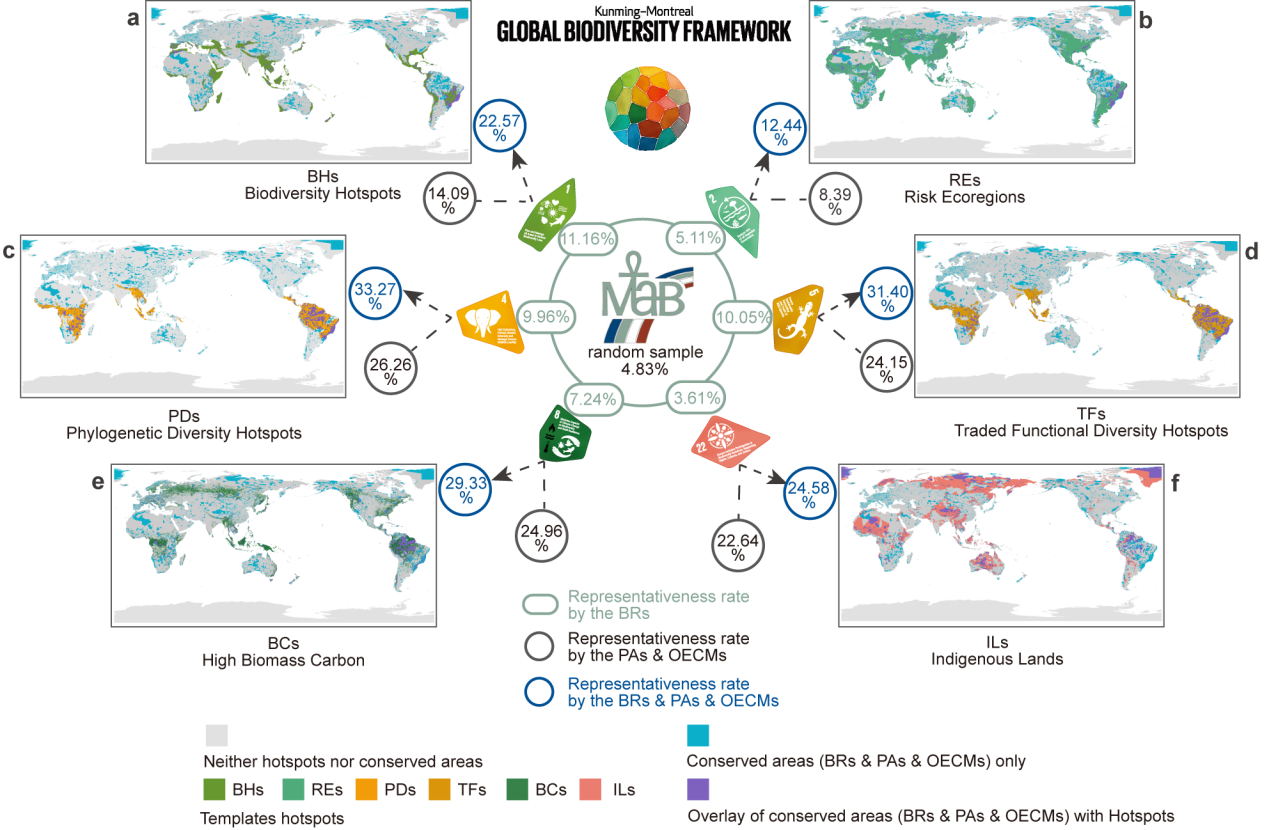
Figure 1 Spatial synergy potential of the Biosphere Reserve Network in advancing multi-target implementation of the Kunming-Montreal Global Biodiversity Framework.
The research findings, titled "Potential of the World Network of Biosphere Reserves to advance the Kunming-Montreal Global Biodiversity Framework," were published online in National Science Review (NSR) on October 21. Postdoctoral Fellow Wu Hui from Tsinghua DESS is the first author of the paper (currently a pre-appointed professor at the College of Forestry, Northeast Forestry University). Associate Professor Yu Le from Tsinghua DESS, and Researcher Ma Keping from the Institute of Botany, Chinese Academy of Sciences & Northeast Forestry University are the co-corresponding authors. Co-authors include Professor António Abreu, Director of the Division of Ecological and Earth Sciences at UNESCO and Secretary of the Man and the Biosphere (MAB) Programme; Shu Zufei, Director of the Guangdong Chebaling National Nature Reserve Administration and Head of the "Youth Innovation Group" of the China Biosphere Reserve Network; Researcher Shen Xiaoli and Associate Researcher Zhu Li from the Institute of Botany, Chinese Academy of Sciences; Associate Professor Cao Yue from the School of Architecture, Tsinghua University; Associate Professor Du Zhenrong from Dalian University of Technology; Dr. Hua Ting from the Norwegian University of Science and Technology; Dr. Zhao Jianqiao from China Agricultural University; Postdoctoral Fellow Qi Wenchao, doctoral students Liu Tao, Zheng Shijun, and Zhao Qiang from Tsinghua DESS; Master's student Li Yixuan from Imperial College London; undergraduate students Chen Jingxin from the School of Life Sciences, Tsinghua University, and Hou Lijia from Xiuzhong College, Tsinghua University. The research was supported by the National Key R&D Program of China, the National Natural Science Foundation of China, and other grants.
Full Text link: https://doi.org/10.1093/nsr/nwaf449
Written by Wu Hui
Edited by Wang Jiayin
Reviewed by Geng Rui



 Picture News
 Hot News