The Qinghai–Tibet Plateau, often called the “Asian Water Tower”, feeds more than ten major rivers in Asia and provides precious water resources for nearly 40% of the global population. Against the backdrop of global warming, however, this “Roof of the World” with an average elevation exceeding 4,000 m is warming at a rate faster than the global mean. Accurately simulating clouds and precipitation over the Qinghai–Tibet Plateau is not only vital for regional water-resource management but also crucial for safeguarding ecological security. Nevertheless, achieving this objective poses many challenges. On the one hand, cloud observations over the plateau are sparse, which constrains in-depth model evaluation; on the other hand, the “cloud” in numerical models is a physical quantity derived from the atmospheric temperature and humidity states and hydrometeors, whereas the “cloud” observed by satellite remote sensing comes from the retrieval of electromagnetic signals. The two differ substantially in physical nature, which also complicates model evaluation.
To address the scarcity of cloud observations and the inconsistency in cloud definition, the research team led by Professor Lin Yanluan of the Department of Earth System Science (DESS), Tsinghua University, developed the COSP (Cloud Feedback Model Intercomparison Project Observational Simulator Package) satellite simulator for four different cloud microphysics schemes. Combined with observations from the CALIPSO satellite lidar and the CloudSat satellite cloud radar, the team conducted a systematic evaluation of the cloud and precipitation simulation capability of the WRF convection-permitting model over the Qinghai–Tibet Plateau (with a horizontal resolution of 3.7 km) during summer.
The evaluation results show that, although all four microphysics schemes can reproduce the bimodal structure of the cloud vertical distribution, they generally exhibit a systematic bias of too many high clouds and too few mid–low clouds. Among them, the Morrison double-moment scheme shows the most significant bias, with a positive bias of more than 110% for high clouds and a negative bias of up to 57% for low clouds. The analysis indicates that the over-simulation of high clouds mainly stems from the overly high cloud-ice number concentration predicted by this scheme near the tropopause, which leads to a smaller ice crystal radius and a lower fall speed, causing cloud ice to accumulate in large amounts near the tropopause. The bias in cloud simulation directly affects the accuracy of radiative fluxes. Using data from 11 ground stations over the plateau, the study finds that all schemes overestimate the downward shortwave radiation reaching the surface; the positive bias of the Thompson scheme even approaches 120 W/m⟡. The reason for this bias is that the deficiency of mid–low clouds allows excessive solar radiation to penetrate the atmosphere and reach the surface, while the excessive presence of high clouds cannot adequately offset this effect, ultimately resulting in an overestimation of surface solar radiation. Another study by the research team indicates that adopting a Gaussian PDF cloud macrophysics scheme can improve the simulation of low clouds, especially shallow convective clouds, thereby effectively mitigating the overestimation of surface solar radiation.
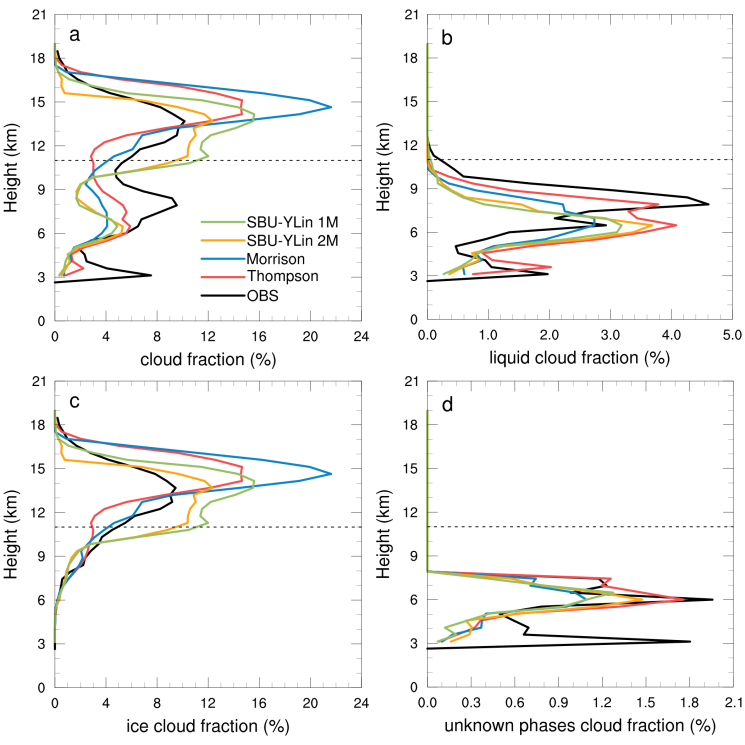
Figure 1 Mean cloud fraction (CF) distributions over the Qinghai–Tibet Plateau along the full trajectories, based on CALIPSO satellite observations and simulation results with different microphysics schemes: (a) total cloud fraction, (b) liquid-water cloud fraction, (c) ice cloud fraction, and (d) unknown-phase cloud fraction (unit: %).
In terms of precipitation simulation, using the dense rain-gauge observations over the Qinghai–Tibet Plateau, the research team evaluated the capability of each scheme in simulating daily precipitation and the distribution of hourly precipitation intensity. The results show that all schemes overestimate the daily mean precipitation across the Qinghai–Tibet Plateau. All schemes produce excessive light rain, while, except for the Morrison scheme, the other schemes underestimate the frequency of heavy precipitation. The pattern of “too much light rain and insufficient heavy rain” may be related to the inadequate representation of cloud microphysical processes (especially liquid–ice phase transitions, the behavior of supercooled water droplets, and related processes). There is an inherent link between the precipitation bias and the cloud bias: the underprediction of mid–low clouds leads to excessive shortwave radiation received at the surface, which in turn enhances the surface sensible heat flux and deep convective activity, ultimately manifesting as overprediction of convective precipitation.
The related study has been published in the Journal of Geophysical Research: Atmospheres under the title “Evaluation of clouds and precipitation in the WRF convection-permitting model over the Tibetan Plateau.” The first author is Zhao Dingchi, a doctoral graduate of Tsinghua DESS (currently working at the National University of Defense Technology). Dong Wenhao, Assistant Professor at Tsinghua DESS, is the corresponding author. The co-authors include Professor Lin Yanluan, Professor Zhang Banglin and Associate Professor Li Yi of the National University of Defense Technology, and Assistant Researcher Jian Bida of Lanzhou University. The paper was supported by the National Natural Science Foundation of China (42430601, 42405159) and the National Major Scientific and Technological Infrastructure “Earth System Numerical Simulation Facility” (EarthLab).
Related paper information:
Zhao, D., K. Miuqian, W. Dong, Y. Lin, B. Jian, Y. Li, and B. Zhang, 2026: Evaluation of Clouds and Precipitation in the WRF Convection-Permitting Model Over the Tibetan Plateau. Journal of Geophysical Research: Atmospheres, 131, e2025JD046099, https://doi.org/10.1029/2025JD046099
Zhao, D., and Coauthors, 2023: Alleviated WRF Summer Wet Bias Over the Tibetan Plateau Using a New Cloud Macrophysics Scheme. Journal of Advances in Modeling Earth Systems, 15, e2023MS003616, https://doi.org/10.1029/2023MS003616
Full-text link: https://doi.org/10.1029/2025JD046099



 Picture News
 Hot News