Atmospheric vapor pressure deficit (VPD), defined as the difference between the saturation vapor pressure and the actual vapor pressure at a given temperature, is a key indicator of atmospheric dryness and evaporative demand. With global warming, VPD has risen sharply since the late 1990s and has become an important environmental factor affecting tree growth, vegetation productivity and the terrestrial carbon sink. The effect of VPD on vegetation growth is distinctly nonlinear. For example, vegetation productivity in high-latitude Eurasia exhibits a VPD threshold of about 0.35–0.40 kPa: below this threshold, rising VPD promotes vegetation productivity, whereas above it the effect gradually turns inhibitory. However, tree species differ in water-use strategy and stomatal regulation, so the critical VPD thresholds governing their growth responses may not be uniform.
To address this problem, Academician Chen Deliang’s team from the Department of Earth System Science (DESS), Tsinghua University, used 2,953 tree-ring sites worldwide to systematically identify the nonlinear responses of tree radial growth to VPD and their critical thresholds at the species level. The study reveals how VPD thresholds vary along climatic gradients, quantifies the historical and future threshold-exceedance exposure risk under different emissions scenarios, and evaluates the buffering effect of potential acclimation- and adaptation-driven threshold shifts on future risk.
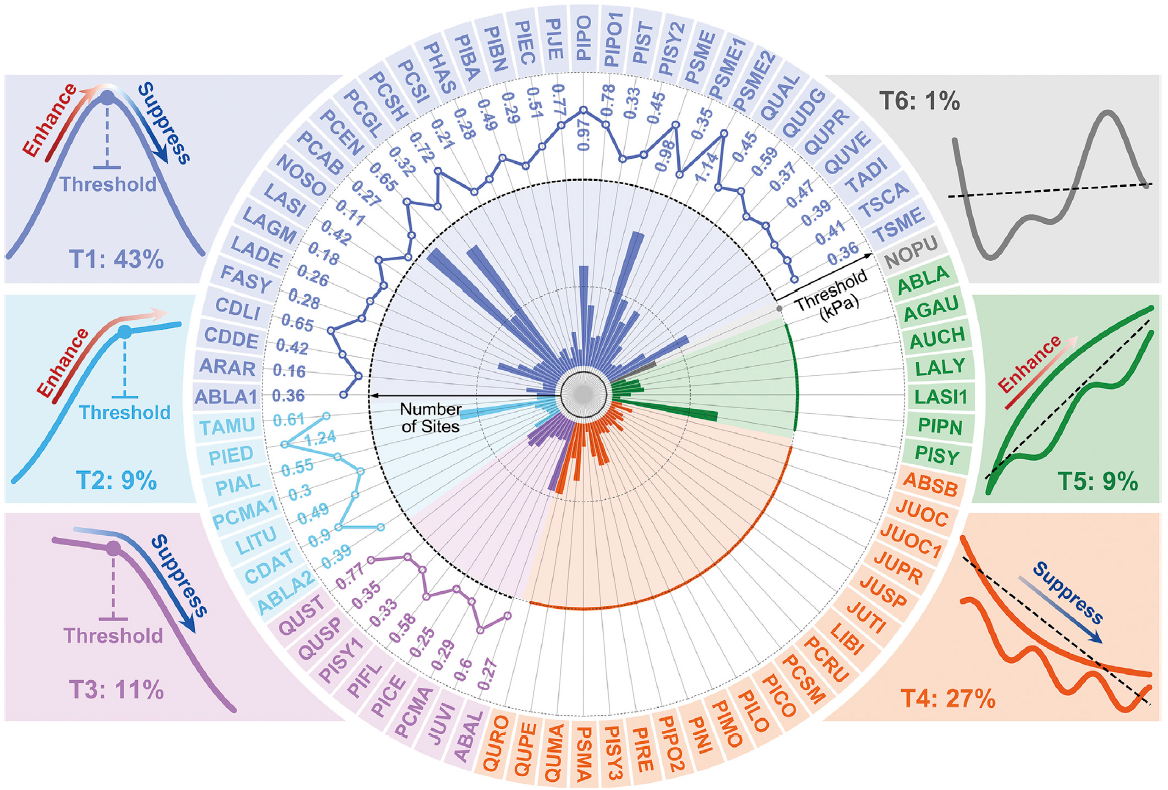
Fig. 1. Six typical response types of tree growth to VPD and the growth-related critical thresholds (Fig. 1 in original paper).
Compiling global tree-ring width records from the International Tree-Ring Data Bank and grouping the 2,953 sites into 76 species groups according to species identity, geographic location and long-term climatic background, the team found that nonlinear responses of radial growth to VPD are widespread. About 43% of the species groups showed a shift from promotion to inhibition as VPD increased; about 9% showed a promotional effect that weakened with rising VPD; and another 11% showed emerging growth inhibition under higher VPD conditions. Overall, approximately 63% of the species groups exhibited an identifiable VPD growth threshold.
The team further tracked growing-season VPD exceedance of the corresponding thresholds at each site from 1901 to 2015. The results show that the proportion of sites exceeding VPD thresholds began to rise rapidly after about 1970, at a rate of about 0.42 percentage points per year, whereas no significant trend existed before 1970. Under future emissions scenarios, the proportion of sites exceeding the VPD thresholds for tree growth will continue to increase, and the divergence among scenarios will widen markedly from the mid-to-late 21st century. In particular, under the high-emissions scenario SSP5-8.5, approximately 79.8% of the study sites are projected to be exposed to VPD above their tolerance thresholds by the end of the century, an increase of 35.6 percentage points relative to the 1970–2015 mean.
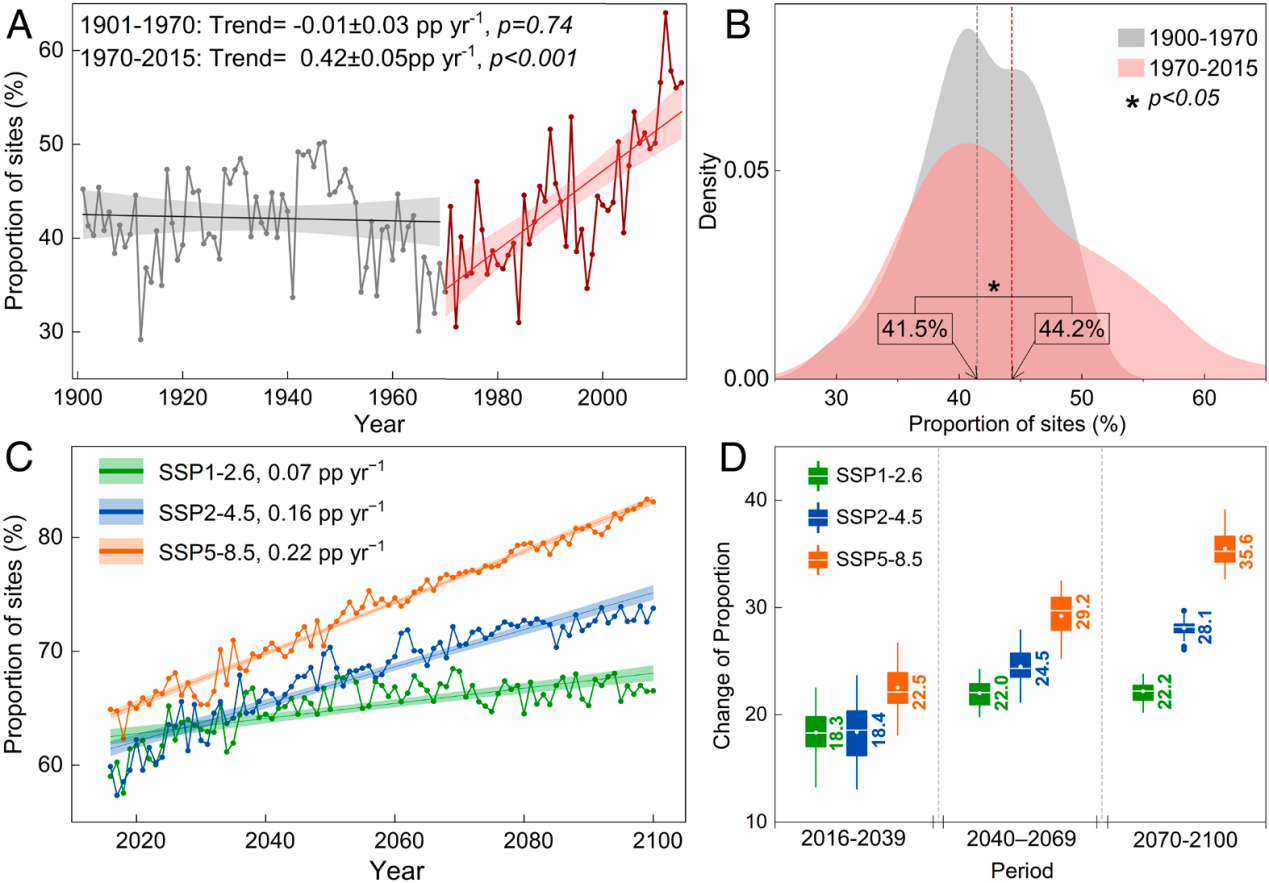
Fig. 2. Historical changes in the proportion of sites exceeding VPD thresholds and projected changes under future emissions scenarios (Fig. 3 in original paper).
Given that trees may alter their VPD response through physiological acclimation or long-term adaptation, the team set up scenarios with different upward threshold shifts to represent varying degrees of acclimation and conducted a sensitivity analysis of future exceedance risk. The results show that upward threshold shifts can reduce the future proportion of exceeding sites to some extent, but this buffering effect weakens as climate forcing strengthens. Under SSP5-8.5, the reduction in exceedance proportion attributable to upward threshold shifts declines from 21.9 percentage points in 2016–2039 to 7.3 percentage points in 2070–2100. Even under a relatively large upward threshold shift, more than 70% of sites remain exposed to above-threshold conditions by the end of the century. These findings indicate that, if physiological acclimation and long-term adaptation can shift the VPD thresholds associated with tree growth upward, they may partly buffer the impact of intensifying atmospheric dryness; nevertheless, under continued and strengthening climate forcing, a limited upward shift cannot fully offset the exceedance risk incurred by the ongoing rise in VPD.
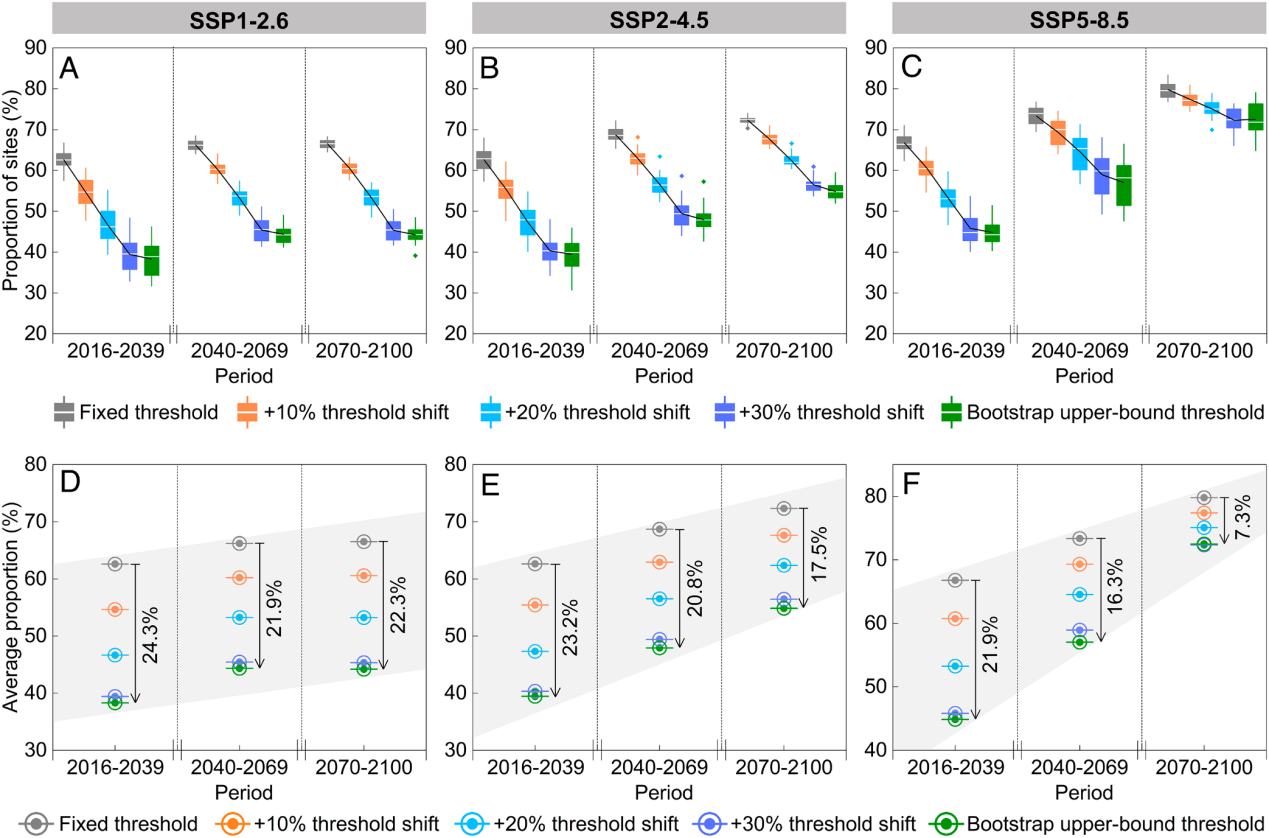
Fig. 3. Sensitivity analysis of the future proportion of sites exceeding VPD thresholds under different hypothetical upward threshold shifts (Fig. 4 in original paper).
The study, entitled “Increasing risk of vapor pressure deficit exceeding critical thresholds for tree growth,” was published in the Proceedings of the National Academy of Sciences (PNAS) on September 8, 2026.
Postdoctoral fellow Li Tiewei from the Department of Earth System Science (DESS), Tsinghua University, is the first author, and Associate Professor He Bin of Tsinghua University is the corresponding author. Co-authors include Academician Chen Deliang, Xinghua Distinguished Chair Professor at Tsinghua University; Professor Hans W. Chen of Chalmers University of Technology, Sweden; Professor Xiao Jinfeng of the University of New Hampshire, USA; Associate Professor Guo Lanlan and Professor Liu Lianyou of Beijing Normal University; Professor Shi Feng of the Institute of Geology and Geophysics, Chinese Academy of Sciences; Professor Yuan Wenping of Peking University; Dr. Zhong Ziqian of Chalmers University of Technology, Sweden; and Dr. Zheng Huan of Beijing Normal University. The research was supported by the National Natural Science Foundation of China and Tsinghua University.
Full-text link: https://doi.org/10.1073/pnas.2530363123
Written by Li Tiewei
Edited by Wang Jiayin
Reviewed by Yu Le



 Picture News
 Hot News