Against the backdrop of global warming, the Qinghai–Tibet Plateau (QTP) is experiencing rising temperatures, altered precipitation regimes, and systematic structural adjustments of its ecosystems. These changes necessitate a climate classification system that can more accurately represent coupled hydrothermal characteristics and their ecological effects in high-elevation regions. Nevertheless, existing classification frameworks lack a moisture dimension, limiting fine-scale characterization of climate zone reorganization across the plateau and associated ecological responses.
To address these issues, the research team led by Professor Chen Deliang from the Department of Earth System Science (DESS), Tsinghua University, in collaboration with Nanjing University of Information Science and Technology and other institutions, incorporated moisture conditions into the classic Köppen–Geiger climate classification framework. This refinement improves the framework’s capacity to characterize coupled hydrothermal assemblages and their ecological effects in high-elevation regions. It provides a novel analytical tool for understanding the evolution of eco-climatic patterns across the Qinghai–Tibet Plateau amid climate change, and delivers a more realistic basis for climate zonation in related disciplines including plateau ecology, soil science and hydrology.
The Köppen–Geiger climate classification is one of the most widely adopted classic climate classification systems globally. Traditional Köppen classification defines polar climates mainly based on temperature thresholds, an approach that reasonably captures the climatic and ecological characteristics of the Arctic and Antarctic. However, while the Qinghai–Tibet Plateau features high elevation and low temperatures, it receives intense solar radiation, with substantial spatial variability in moisture conditions. Vegetation growth is co-limited by temperature and moisture. Accordingly, areas assigned to the same ET climate class under the traditional scheme may display pronounced differences in actual hydrothermal conditions and vegetation status, which hinders adequate representation of the plateau’s complex eco-climatic patterns.
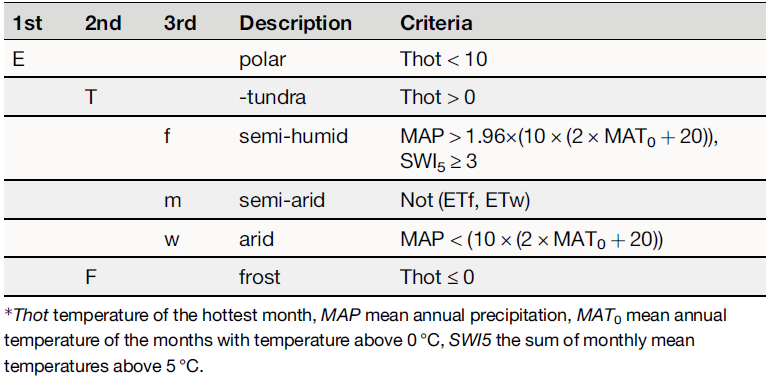
To address this issue, the research team, while fully preserving the temperature–precipitation framework of the Köppen classification, introduced the aridity index (AI) to represent coupled hydrothermal conditions and further subdivided the tundra climate (ET) along the moisture dimension into three sub-classes: semi-humid tundra (ETf), semi-arid tundra (ETm), and arid tundra (ETw). In addition, the study adopted the summer warmth index as a supplementary criterion to reduce classification bias that may arise because much of the snowfall in high-altitude regions is not directly usable by vegetation.
Figure 1 The revised Köppen–Geiger climate classification index system over the Qinghai–Tibet Plateau.
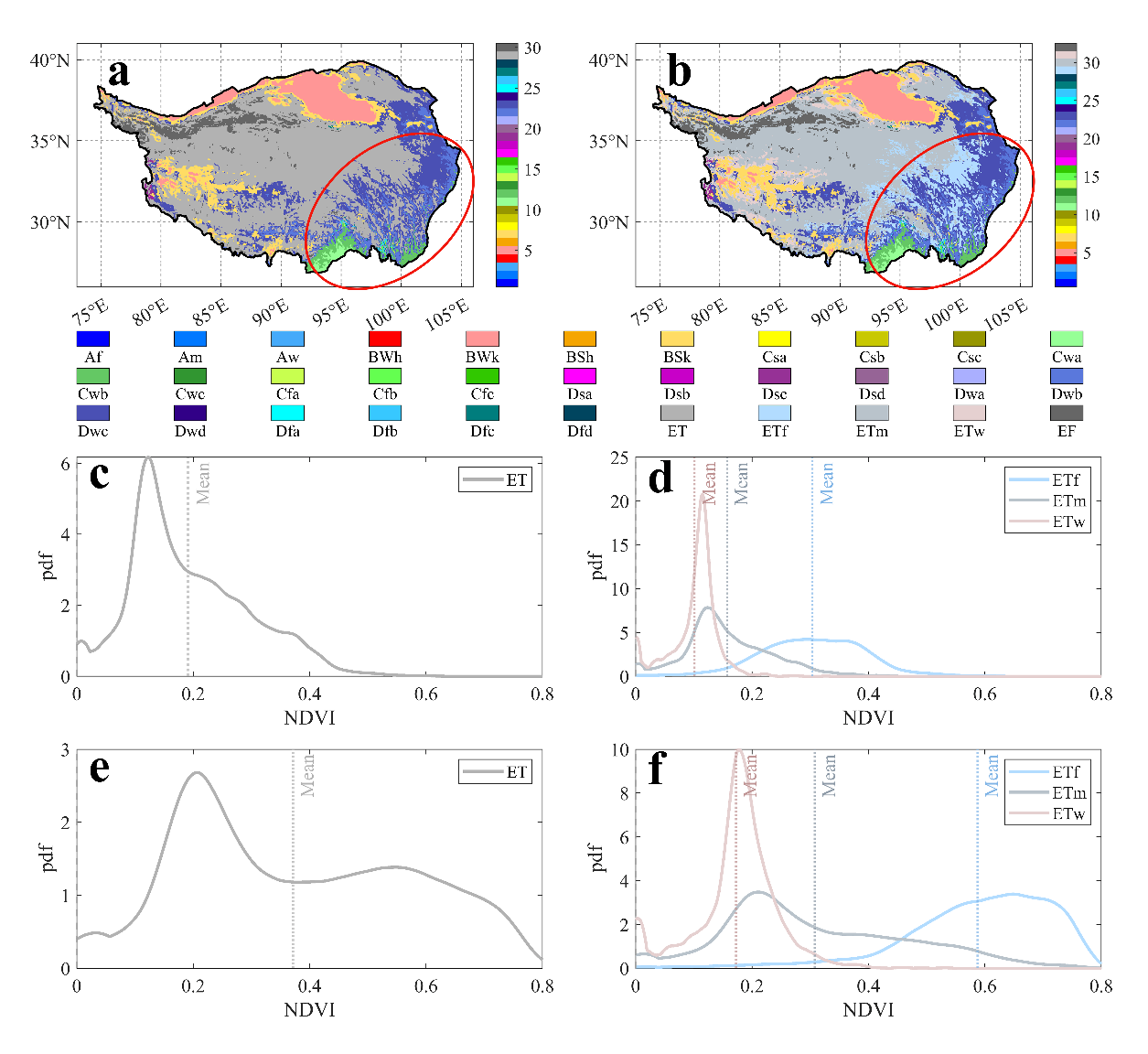
To examine the ecological significance of the revised classification, the research team validated it using satellite-derived Normalized Difference Vegetation Index (NDVI). The results demonstrate that the revised classification can better distinguish vegetation cover differences under varying hydrothermal conditions, substantially reducing the large within-class vegetation heterogeneity for the same ET type in the traditional scheme. Based on 1991–2020 average climate conditions, some alpine-valley regions on the eastern Qinghai–Tibet Plateau are primarily identified as semi-humid tundra (ETf); the main body of the central and western plateau is dominated by semi-arid tundra (ETm); and arid tundra (ETw) occurs mainly in zones extending from the margins of arid areas toward the plateau interior. NDVI distributions across these subclasses exhibit clearer contrasts, indicating that the revised classification corresponds more closely to field vegetation conditions.
Figure 2 Spatial distribution of Köppen–Geiger climate types and vegetation conditions based on 1991–2020 average climate conditions. The revised classification can more clearly distinguish the vegetation characteristics of different tundra climate sub-types.
Based on long-term meteorological data from 1979–2023, the study further revealed notable changes in climate types over the Qinghai-Tibet Plateau. Over the past 45 years, climate-type transitions occurred over an area of about 280,000 km⟡: the polar climate (E) contracted overall, the ice-cap climate (EF) nearly halved in area, and the cold climate (D) expanded markedly; meanwhile, large-scale transitions also occurred among the different moisture sub-types within the tundra climate (ET). The study shows that climate change over the Qinghai-Tibet Plateau is not manifested solely as rising temperatures, but is accompanied by co-changes in hydrothermal conditions and a reorganization of climate zones.
The research team also applied the revised scheme to typical mountain regions worldwide, including the Andes, the Alps, and the Rocky Mountains. The results indicate that, with parameter calibration tailored to different mountain ranges, this classification approach holds potential for further application and generalization.
The related research findings have been published in npj Climate and Atmospheric Science under the title “A revised Köppen climate classification reveals hydrothermal controls on eco-climate over the Qinghai–Tibet Plateau.”
Professor Chen Tiexi of Nanjing University of Information Science and Technology is the first author and a co-corresponding author of the paper, and Professor Chen Deliang of Tsinghua DESS is a co-corresponding author. The research was co-completed by Tsinghua University, Nanjing University of Information Science and Technology, Qinghai Institute of Technology, Beijing Normal University, the Helmholtz Centre for Environmental Research and Leipzig University. The research was supported by the Tsinghua University Carbon Neutrality and Energy System Transition Project, the Qinghai Provincial Innovation Platform Project, and the National Natural Science Foundation of China, among others.
Full-text link:
DOI:10.1038/s41612-026-01539-w
Written by Chen Deliang and He Bin
Edited by Wang Jiayin
Reviewed by Yu Le



 Picture News
 Hot News