On July 16, China’s first integrated hydropower-wind-solar smart operation large model was officially released in the Yalong River basin in Sichuan, marking a new stage in the digital transformation of China’s ten-million-kilowatt-level clean energy base. The team of Academician Chen Deliang from the Department of Earth System Science (DESS), Tsinghua University, deeply integrated the macro vision of Earth system science with artificial intelligence technology, providing key scientific guidance for clean energy development in the Yalong River basin. This collaboration not only supports efficient production, dispatch and utilization of new energy, but also serves as a vivid example of developing a new energy system with climate resilience.”

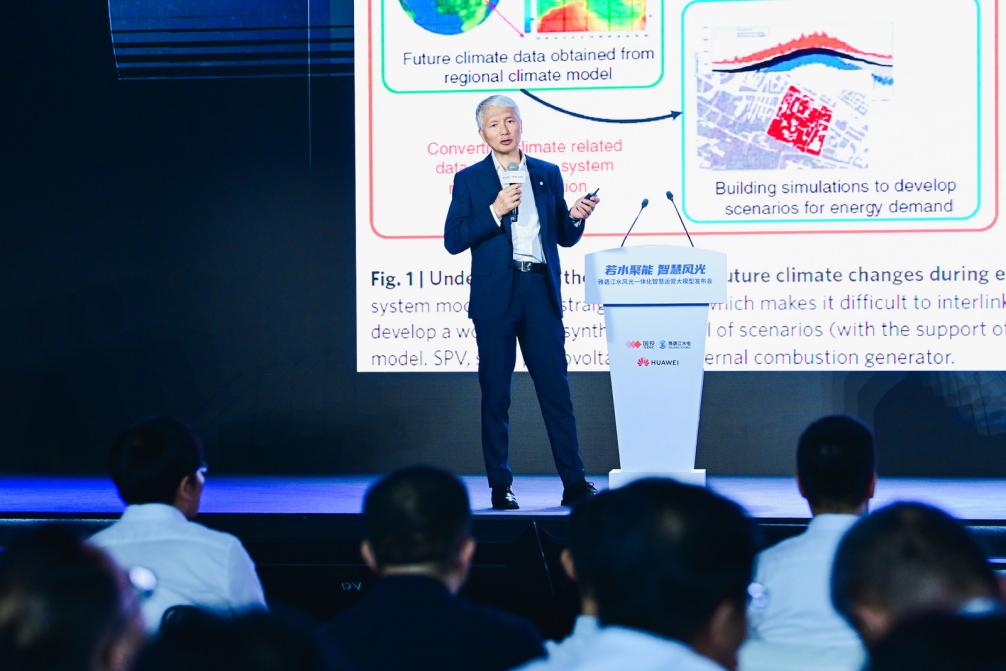
Chen Deliang delivers a report at the launch conference of the Yalong River large model.
Earth System Science: From “Living at the Mercy of the Weather” to “Foreseeing Winds and Clouds”
For decades, renewable energy sources including wind, solar and hydropower have long been seen as sectors “living at the mercy of the weather.” Against the backdrop of global warming, extreme weather events are becoming more frequent, posing unprecedented challenges to the security of energy systems.
“Climate change is reshaping the future of China’s renewable energy,” Chen Deliang pointed out. High-impact weather events can substantially amplify supply-demand risks for future wind and solar power systems. According to the team’s research, as global mean temperatures rise, events including extreme heat, heavy rainfall and droughts will grow more frequent. For energy systems, this means planning that relies solely on historical meteorological data is no longer robust.
“We are not merely conducting weather forecasting; we are performing ‘risk anticipation’ for energy systems,” Chen Deliang noted in an interview. By assembling massive datasets from satellite remote sensing, ground meteorological stations and other sources and implementing integrated forecasting covering the entire river basin, all variables and multiple time scales, the Yalong River large model can anticipate “changing weather patterns” in advance. It guides hydropower stations, wind farms and photovoltaic plants in coordinated dispatch, effectively mitigating the risk of energy supply disruptions triggered by extreme weather.
Climate Resilience: The “Safety Valve” for Energy Transition
Driven by the “dual carbon” goals, the share of installed new energy capacity is rising rapidly; however, safeguarding energy system security under extreme climate conditions is a major challenge facing the entire industry. In this collaboration, the team from Tsinghua DESS introduced the core concept of “climate resilience.” “Climate resilience is not just about recovering quickly after a disaster; more importantly, it is about pre-disaster anticipation and adjustment during operation,” Chen Deliang emphasized. Traditional energy dispatch is often passive, whereas the Yalong River large model developed based on the scientific concept of “climate resilience” will empower the energy system with the ability to “actively transform.”
The Yalong River large model demonstrates that Earth system science approaches can substantially boost the “immunity” of energy systems against climate shocks. Chen Deliang noted that over the next 5–10 years, the “tipping point” for energy transition may emerge at the nexus of expanding new energy deployment and inadequate system flexibility. Only via interdisciplinary system science approaches that integrate the full workflow of meteorological and hydrological modelling, wind‑solar resource forecasting, and power operational decision-making can we develop a safe, efficient and green new energy system before this tipping point is reached.
Moving forward, Tsinghua DESS will further advance research on “artificial intelligence + Earth system science.” Taking the clean energy base in the Yalong River basin as a model, it aims to deliver more robust scientific support for national energy security and ecological civilization development.
Text by Wang Jiayin
Reviewed by Chen Deliang, Lu Hui, and Yu Le



 Picture News
 Hot News