Forests hold significant potential for mitigating climate change and are widely regarded as "nature-based climate solutions." Forest carbon projects established under forest carbon protocols increase or maintain forest carbon stocks through afforestation, forest restoration, and improved forest management practices. By monetizing carbon sink values through carbon credit/offset mechanisms, these projects have become an important pathway in contemporary climate governance.
However, the climate mitigation effect of such projects hinges on the stable storage of forest carbon over timescales of decades to centuries—a property referred to as "durability." To guard against unintended forest carbon losses, existing forest carbon protocols generally employ a buffer pool mechanism, which withholds a portion of carbon credits as a risk reserve to compensate for carbon losses resulting from disturbances such as wildfires, droughts, and pest infestations. Yet intensifying climate change may accelerate forest carbon losses and trigger "reversal"—a process in which carbon stored in forests is re-released into the atmosphere—thereby undermining the durability of forest carbon storage and compromising the effectiveness and market credibility of forest carbon projects. Consequently, how to scientifically assess the risk of forest carbon reversal and reasonably determine the size of buffer pools has become a critical issue for ensuring the long-term stability and reliability of forest carbon markets.
To address this critical scientific question, an international research team led by Assistant Professor Wu Chao from the Department of Earth System Science (DESS) at Tsinghua University employed an interdisciplinary approach, with a specific focus on California's forest carbon project—the largest climate change mitigation program of its kind in the United States. The team produced spatially explicit maps of forest carbon reversal risk over a century-scale horizon, evaluated the required buffer pool size and its associated uncertainties, and revealed that current forest carbon protocols significantly underestimate the risk of climate-driven carbon losses.
By integrating U.S. forest inventory data, forest disturbance records, and climate simulation outputs, the study developed two complementary approaches for assessing forest carbon reversal risks. Spatially explicit maps were generated to illustrate the century-scale risk of carbon reversal across U.S. forests resulting from three types of natural disturbances—wildfires, droughts, and pest infestations (Figure 1).
The study reveals that, under future climate scenarios, the area at risk of forest carbon reversal will expand substantially. Notably, the proportion of forest area projected to experience carbon losses from wildfires is expected to increase from 10% to 33%. In particular, large parts of Idaho, Southern California, Arizona, and New Mexico face a greater than 80% probability of wildfire-driven carbon loss over the coming century.
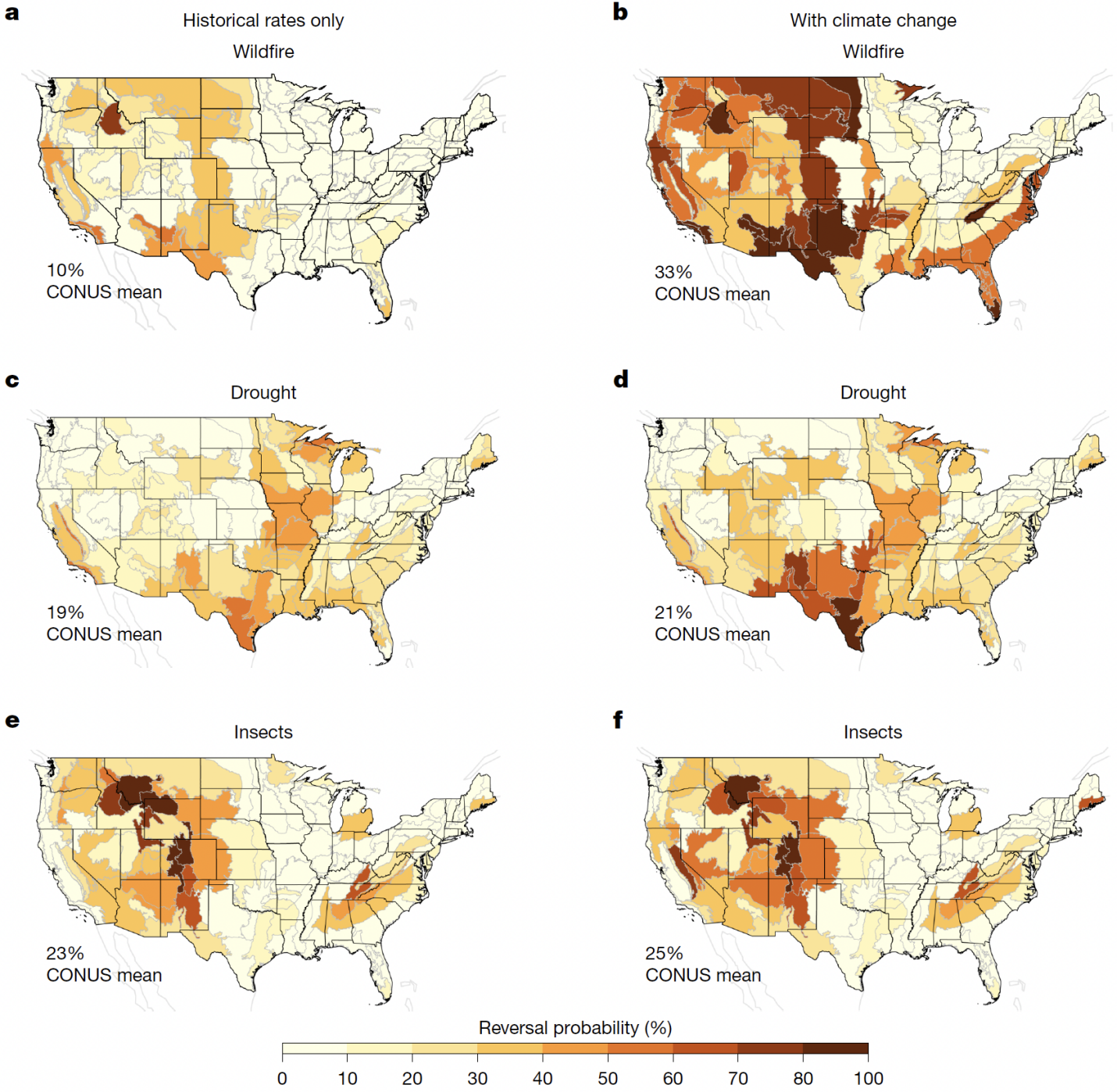
Figure 1 Century-scale forest carbon reversal risks across the United States driven by wildfires (a, b), droughts (c, d) and pest infestations (e, f). Panels a, c and e represent scenarios without climate change; panels b, d and f represent scenarios with climate change incorporated.
The team further produced high-resolution, spatially explicit maps of the required buffer pool size at the national forest scale to offset carbon reversal risks arising from different types of disturbances (Figure 2a–c). These outputs can serve as a scientific basis for determining buffer pool sizes in forest carbon projects across different regions.
The study focused on 116 existing compliance forest carbon offset projects in California, identified their exposure to carbon reversal risks, and quantitatively assessed the buffer pool size required to offset unintended forest carbon losses caused by wildfires, droughts, and pest disturbances over the next century. The total required buffer pool for these projects is estimated at approximately 82.4 million tons of CO₂ equivalent—roughly 6.2 times larger than the current buffer pool actually in place within these projects (Figure 2d, e).
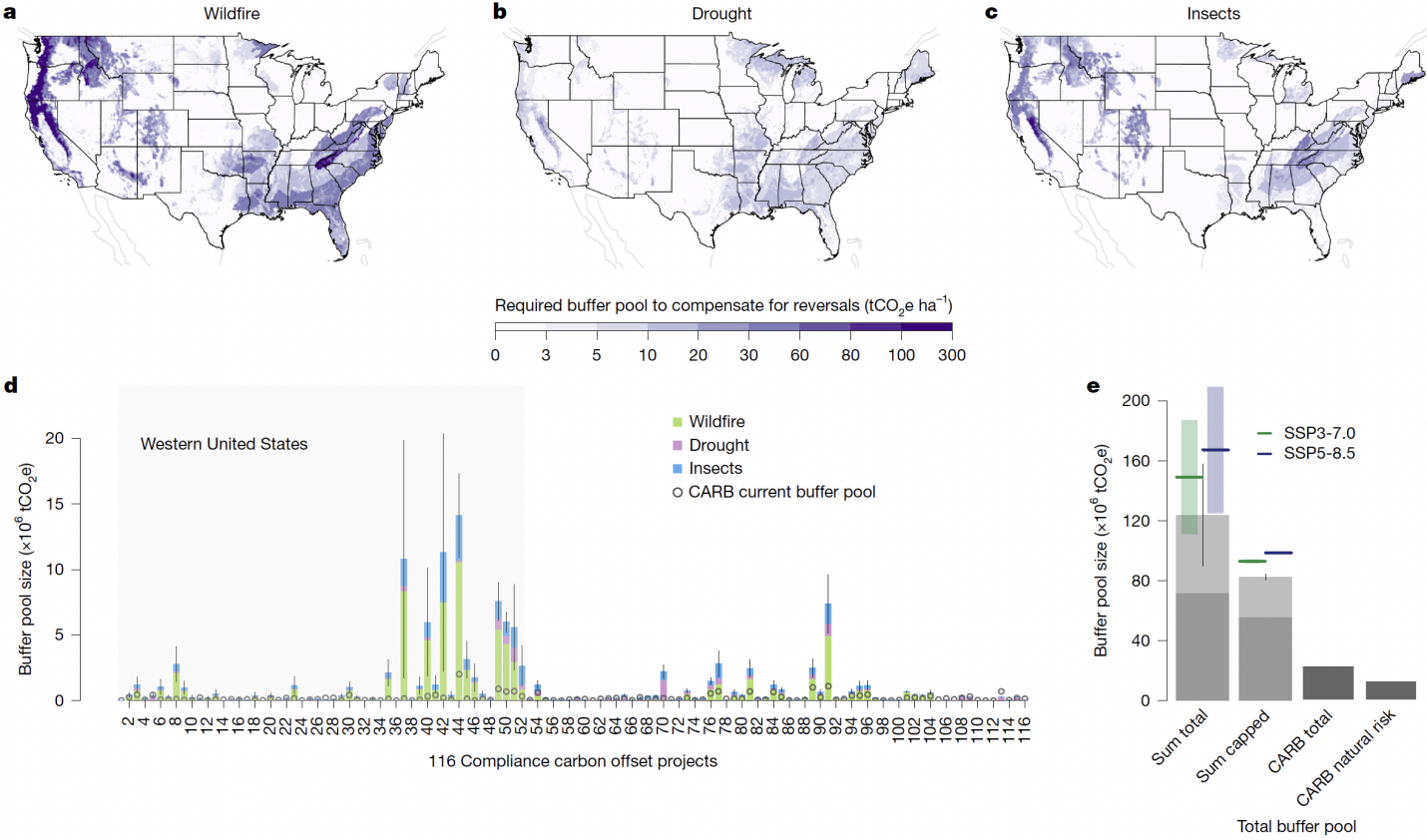
Figure 2 Current buffer pools for U.S. forest carbon projects are substantially underestimated. (a–c) Required buffer pool size across U.S. forests to offset carbon reversals driven by wildfires, droughts, and pest infestations; (d) Comparison of the buffer pool size estimated in this study versus the current buffer pool size adopted by carbon projects at the individual project level; (e) Comparison at the aggregate level.
The research team further conducted a systematic uncertainty analysis of buffer pool size estimation, taking into account multiple factors including future climate scenarios, disturbance intensity variability, post-disturbance salvage logging, other relevant carbon pools (e.g., long-lived wood products, standing dead trees, and post-disturbance vegetation regrowth), and dynamic buffer pool modeling. The results indicate that the total buffer pool of California's forest carbon projects remains underestimated by a factor of 2.2 to 8, with an average of 6.3 (Figure 3).
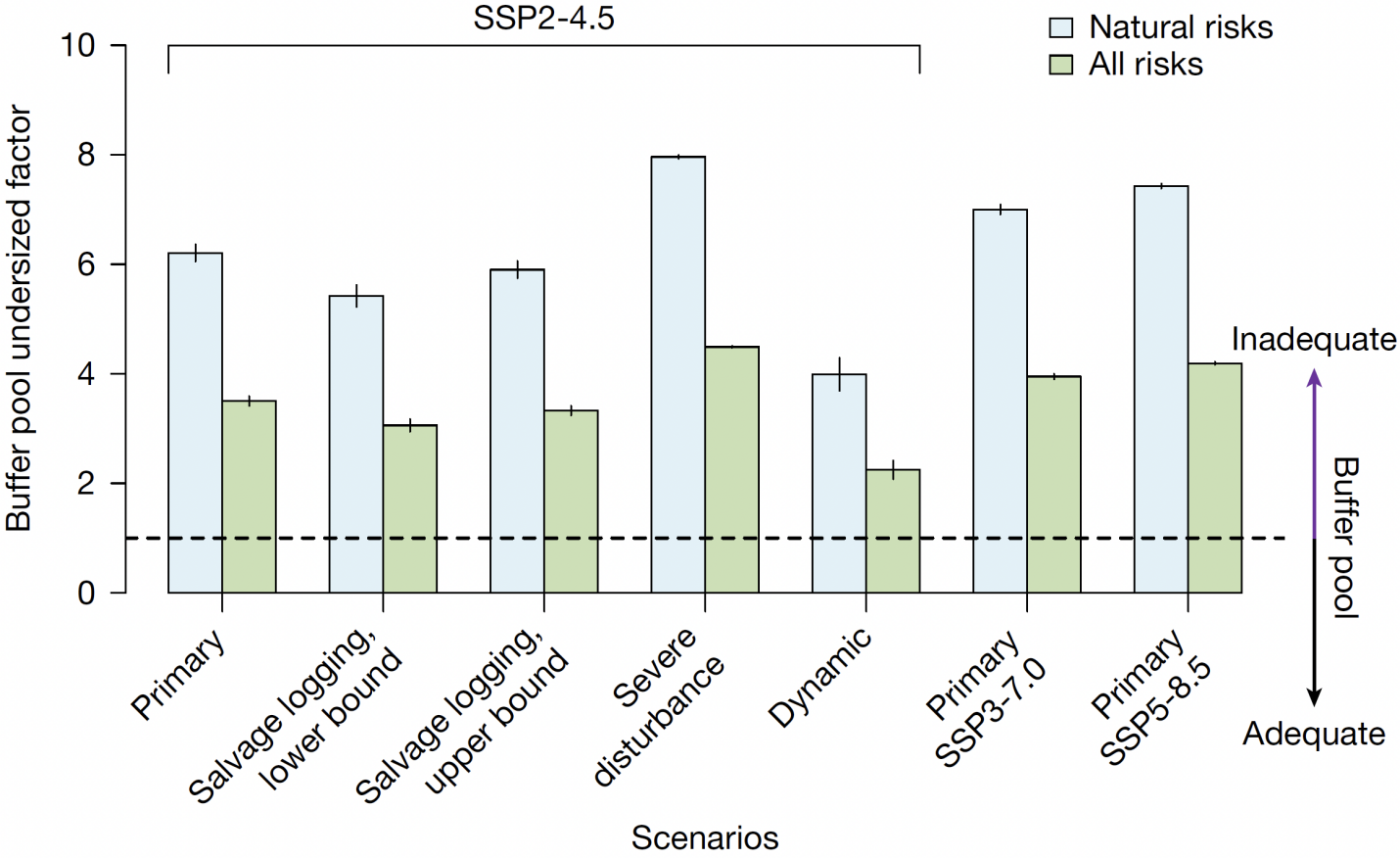
Figure 3 Forest carbon durability risks are substantially greater than buffer pool protections.
The findings of this study establish a unified quantitative framework for assessing century-scale, climate-driven forest carbon reversal risks. This framework provides a scientific basis for addressing the core issue of “durability” within carbon crediting systems, and offers critical technical support for the methodological revision of forest carbon protocols, the optimization of investments in forest-based climate solutions, and the development of relevant standards under Article 6.4 of the Paris Agreement.
The research, entitled "Forest carbon protocols underestimate climate-driven carbon loss risks," was published online in Nature on May 20, 2026. This study represents another major achievement by the international research team in the fields of climate risk and forest-based climate solutions, following their earlier landmark publications: a global climate risk analysis of forests in Science (2022), an assessment of climate risks to forest carbon storage potential in Nature Geoscience (2023), and a Perspectives article on advancing more effective forest-based climate solutions in Nature (2025).
Assistant Professor Wu Chao from the Department of Earth System Science (DESS), Tsinghua University, serves as both first author and corresponding author. Professor William Anderegg from the University of Utah is the co-corresponding author. Collaborators include researchers from eight international institutions such as the University of California, Irvine, The Nature Conservancy (TNC) and Stanford University. The work was funded by the Tsinghua University Dushi Special Program and other research grants.
Full-text link:
https://www.nature.com/articles/s41586-026-10571-y
Related results:
https://www.science.org/doi/full/10.1126/science.abp9723
https://www.nature.com/articles/s41561-023-01166-7
https://www.nature.com/articles/s41586-025-09116-6
Written by Wu Chao
Edited by Wang Jiayin
Reviewed by Yu Le



 Picture News
 Hot News