The plant economics theory holds that plants evolve a continuous strategy spectrum ranging from resource acquisitive to resource conservative via ecological trade-offs, which are manifested through combinations of functional traits such as leaves and fine roots. Nonetheless, the correlation between the Leaf Economic Spectrum (LES) and the Root Economic Space (RES) has long been debated in academia. The whole-plant economic spectrum hypothesis proposes that leaf and fine root traits change synergistically driven by physiological coupling. However, numerous studies have detected functional decoupling between these two organ types.
A major limitation accounting for inconsistent findings in existing research is that most studies fail to isolate the effects of environmental gradients. When leaf and fine root traits respond convergently to climatic or soil nutrient conditions, a statistical correlation will emerge between them. This makes it difficult for researchers to distinguish whether the observed association stems from physiological coupling across plant organs or environment-driven trait covariation.
To address this problem, Associate Professor Wang Han's research group from the Department of Earth System Science (DESS) at Tsinghua University selected two communities with contrasting environmental conditions—a hilltop site and a valley site—within a subtropical evergreen broad-leaved forest in Shanghang County, Fujian Province. They conducted paired sampling of leaves and fine roots from 87 woody plant individuals belonging to 41 coexisting species, and measured 18 functional traits covering morphological, chemical, and physiological dimensions. This study examined the coordination between root and leaf economic traits at the community level, while accounting for trait covariation potentially induced by environmental gradients. In addition, the study adopted an individual-level paired sampling strategy, thereby avoiding the uncertainties associated with intraspecific variation that are typically neglected by conventional species-averaging approaches.
The results show that, in pairwise trait relationships between leaves and fine roots, the majority of morphological and chemical traits exhibit no significant cross-organ covariation. For example, no significant correlations were found between leaf nitrogen content and root nitrogen content, or between leaf mass per area and specific root length, among other paired traits. In multivariate dimension reduction analyses, the Root Economic Space (RES) exhibits a two-dimensional structure composed of a "collaboration" axis and a "conservation" axis, whereas the Leaf Economic Spectrum (LES) is oriented orthogonally to the RES in the reduced trait space. This pattern is consistently observed both across and within communities, indicating a stable decoupling between the variations of leaf and fine root functional traits. Furthermore, phylogenetic comparative analyses confirm that the orthogonality between LES and RES remains robust after accounting for phylogenetic signals, suggesting that the decoupling of leaf and fine root traits is an intrinsic ecological strategy of coexisting plant species, rather than a consequence of evolution.
Based on the above findings, this study proposes a mechanistic framework of "heterogeneity-driven decoupling and convergent selection-promoted covariation." In resource-abundant, species-rich subtropical forests, microenvironmental heterogeneity may subject leaves and fine roots to divergent selective pressures, driving the two organs to optimize independently and thereby reducing interspecific competition. In contrast, in resource-limited ecosystems or across larger spatial scales, shared environmental filters narrow the range of viable trait combinations and facilitate covariation between root and leaf traits. This framework helps reconcile previous inconsistent findings regarding root–leaf trait relationships and offers a novel functional-trait perspective for understanding species coexistence mechanisms in highly diverse forest ecosystems.
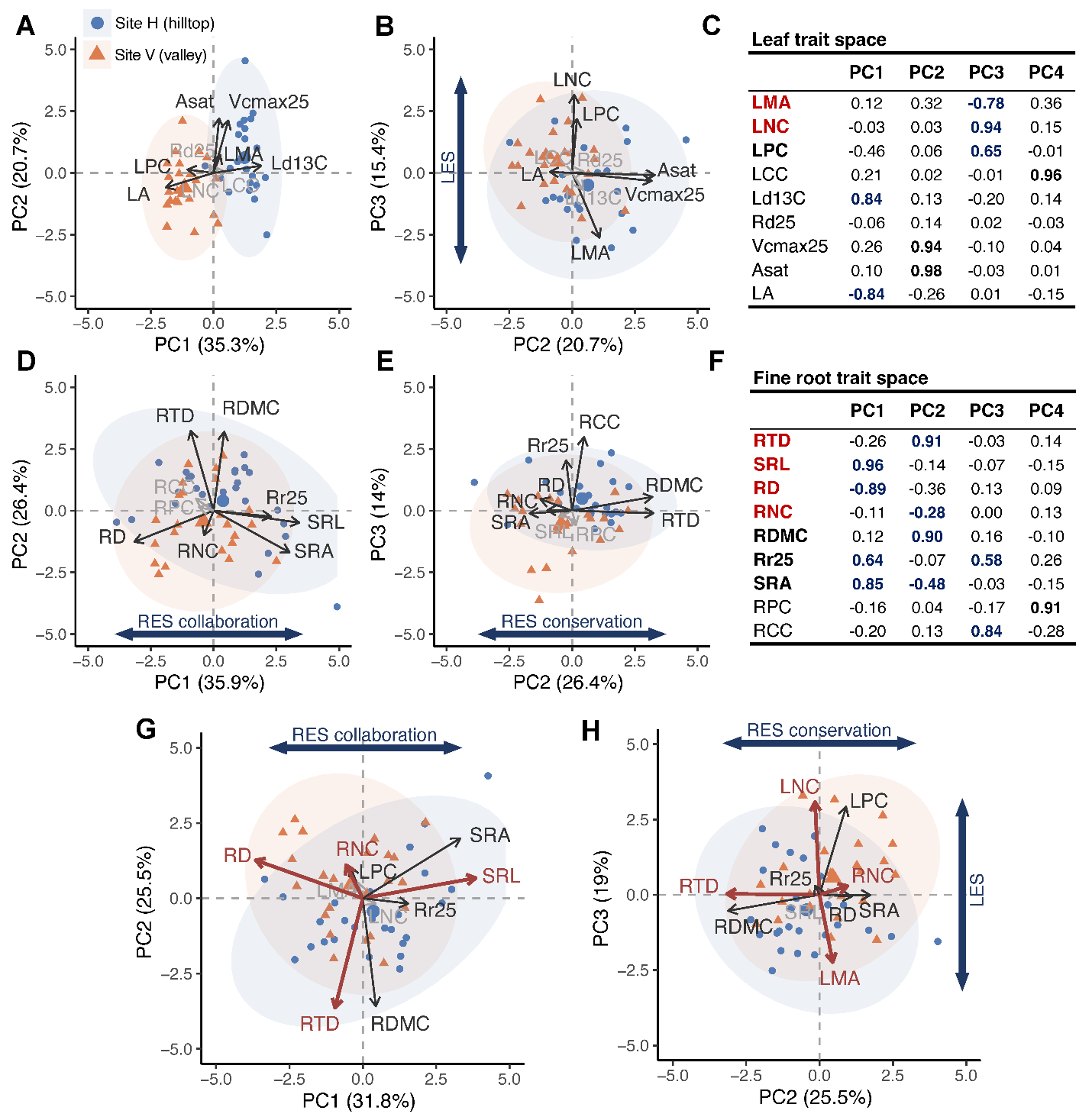
Figure 1 Decoupling patterns between the Leaf Economic Spectrum and Root Economic Space in subtropical evergreen broad-leaved forest communities (A–B); Structure and composition of the dimension-reduced leaf trait space (D–F); Structure and composition of the dimension-reduced fine root trait space; (G–H) Integrated fine root and leaf economic space, illustrating the decoupling between leaf and fine root economic axes
The relevant results were published online in Ecology Letters in May 2026 under the title “Non-correlated variation of leaf and fine root traits in subtropical forest plants”. Zhu Yuzhi, a PhD candidate at the Department of Earth System Science (DESS), Tsinghua University, is the first author, and Associate Professor Wang Han is the corresponding author. Collaborators include researchers from multiple domestic and international institutions, such as Fujian Normal University, Nanjing Forestry University, the University of Reading, Imperial College London, the University of Minnesota and Western Sydney University. This study was funded by the National Key R&D Program of China and other research projects.
Full-text link:
https://doi.org/10.1111/ele.70397
Written by Zhu Yuzhi
Edited by Wang Jiayin
Reviewed by Yu Le



 Picture News
 Hot News