The low-carbon transition of the health-care sector has become a critical issue on the global climate and health agenda. Although previous studies have quantified the environmental impacts of health-care systems at national and global levels, the disparities in health-care carbon footprints (HCFs) across different income groups—particularly within countries—and their trajectories have remained insufficiently assessed.
To address this gap, Professor Cai Wenjia’s Research Group from the Department of Earth System Science (DESS) at Tsinghua University conducted a systematic assessment of health-care carbon footprints from a population-disparity perspective, further analyzing the mitigation potential of equity-oriented demand-side interventions in achieving low-carbon health-care systems.
By integrating consumer expenditure surveys, national health expenditure data, and a global multiregional input-output model from 121 countries (2005–2017), the study characterized the distribution of health-care carbon footprints across population groups with different income and health spending levels at the global scale, distinguishing emission sources across various health-care service categories and products. Building on this, scenario analyses were developed to systematically evaluate the potential of demand-side interventions to reduce health-care-related carbon emissions while maintaining or even expanding access to care.
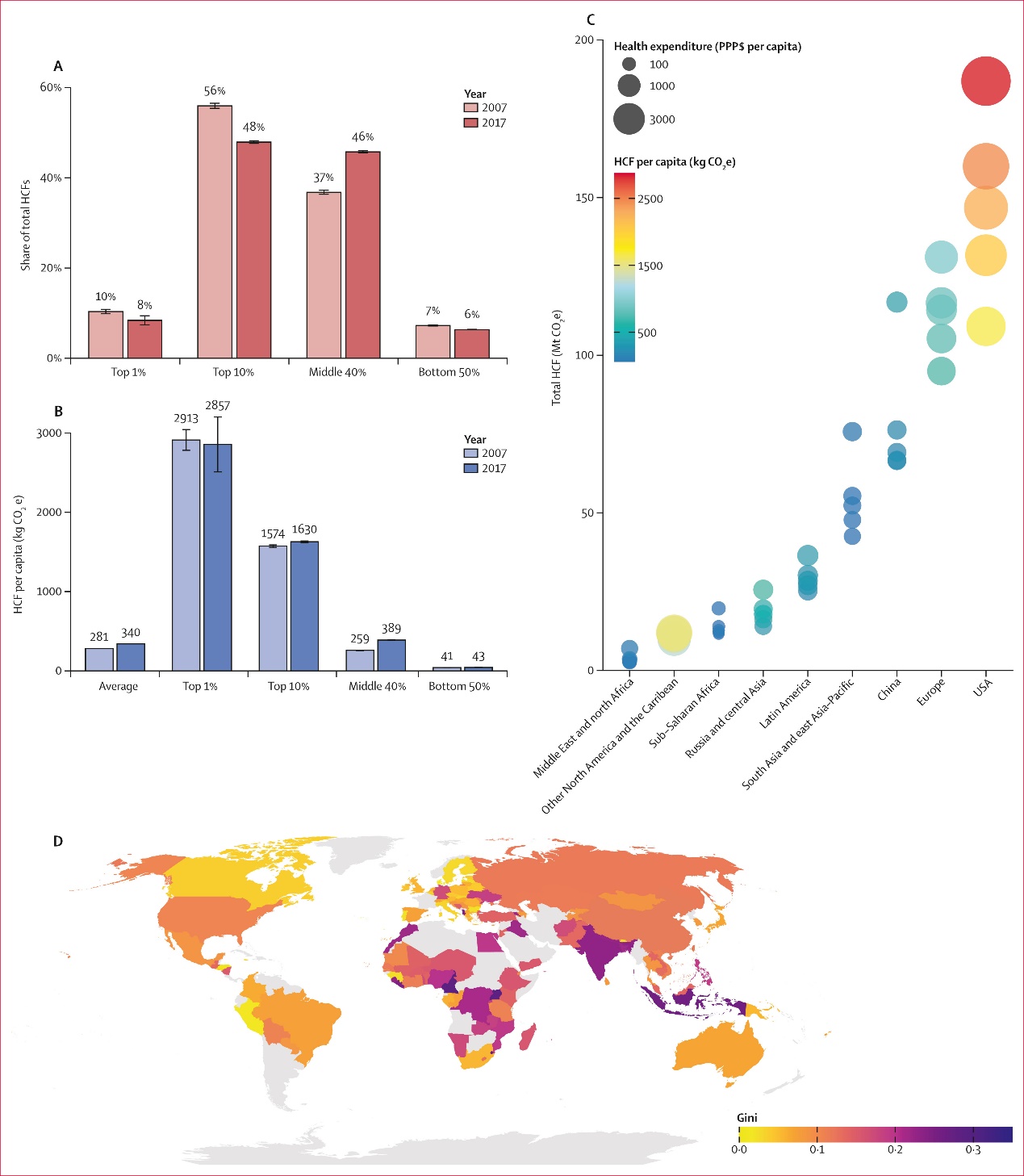
Figure 1: Inequalities in global health-care carbon footprints
The findings reveal that health-care carbon footprints are highly uneven both between and within countries. By 2017, the top 10% of global health-care consumers by spending contributed approximately 48% of total HCFs, whereas the bottom 50% contributed less than 10%. Among them, the top 1% of high-spending consumers had a per-capita HCFs of approximately 2857 kg CO₂e—more than eight times the global per-capita average and nearly 66 times that of the bottom 50%. Further analysis indicated that high-spending groups exhibit a higher “marginal emission intensity” of health-care consumption, meaning that each additional unit of health expenditure among these groups entails substantially higher embodied carbon emissions compared with low-spending groups. Based on these characteristics, the study evaluated the emission reduction effects of different demand-side intervention pathways through scenario simulations.
The results show that, without compromising health outcomes, managing carbon-intensive overuse of health care among the top 10–20% of global health-care consumers while simultaneously advancing universal health coverage could reduce health-care carbon footprints by approximately 25–40%. These emission reductions far exceed the additional carbon emissions associated with expanding essential health-care services.
The study emphasizes that achieving an equitable and low-carbon transformation in healthcare hinges not only on national average standards and aggregate control, but also on taking intra-national population differences into account. It is critical to identify key healthcare segments with high expenditure-emission elasticity and carry out targeted interventions.
This research provides systematic quantitative evidence for health-care climate actions that balance equity, efficiency, and emission reduction. In doing so, it unlocks substantial carbon mitigation potential while safeguarding access to care, offering policymakers a scientific basis to resolve the dilemma between development and emission reductions.
The study, titled “Inequalities in health-care carbon footprints and implications for demand-side interventions: a global assessment across population groups,” was published in The Lancet Planetary Health on May 12, 2026. Dr. Zhao Han, a postdoctoral researcher at Tsinghua DESS, is the first author, and Professor Cai Wenjia is the corresponding author. Co-authors include Zhang Shangchen (PhD candidate, Class of 2022), Lei Mingyu (PhD candidate, Class of 2023), and Assistant Professor Zhang Shihui (School of Ecology and Environment, Renmin University of China). The research was supported by the National Natural Science Foundation of China, the Youth Innovation Team of the China Meteorological Administration, and the Tsinghua-Rio Tinto Joint Research Center for Resource Energy and Sustainable Development.
Link to full-text paper: https://www.thelancet.com/journals/lanplh/article/PIIS2542-5196(26)00029-X
Written by Zhao Han
Edited by Wang Jiayin
Reviewed by Yu Le



 Picture News
 Hot News