Achieving net-zero CO₂ emissions is central to addressing climate change and meeting the temperature goals of the Paris Agreement. To scientifically assess the key issues underlying China's carbon neutrality pathway, it is necessary to quantify, within a unified framework, current CO₂ emissions, along with the contributions of terrestrial ecosystems, land-use change, anthropogenic carbon removals, non-fossil energy substitution and energy efficiency improvements to achieving a net-zero carbon budget.
To address these challenges, a research team led by Professor Liu Zhu from the Department of Earth System Science (DESS), Tsinghua University, in collaboration with domestic and international partners, has synthesized data from emission inventories, terrestrial ecosystem models, land-use change estimates, coastal and marginal sea carbon fluxes, and anthropogenic carbon removals. Based on data from 1970 to 2024, they have developed a carbon budget framework for China to achieve net-zero emissions by 2060. This framework incorporates lateral carbon fluxes associated with rivers and trade, and separately tracks "Scope 4" avoided emissions, providing a systematic and quantitative reference for evaluating the key pathways and uncertainties in achieving carbon neutrality in China before 2060.
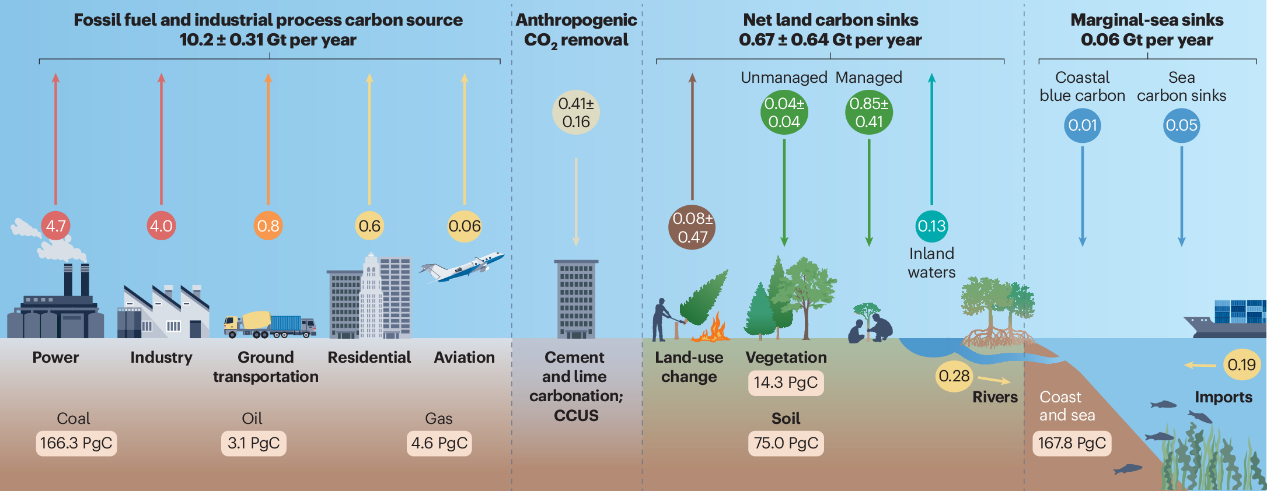
Fig. 1 Mean annual sources and sinks of carbon in China between 2014 and 2024.
The study points out that a regional net-zero carbon budget differs from the global carbon budget and must simultaneously consider both natural and anthropogenic sources and sinks within the region, as well as cross-regional lateral carbon transfers. The study incorporates China's terrestrial region and adjacent marginal seas into a comprehensive assessment framework, reporting marginal sea carbon sinks separately and not using them as policy accounting items to offset fossil fuel emissions. Through this approach, the study establishes a clearer boundary between a closed physical carbon cycle and net-zero policy accounting.
The study emphasizes the inclusion of Scope 4 avoided emissions in assessing regional net-zero progress. Scope 4 avoided emissions do not represent atmospheric CO₂ removal. Instead, they refer to the CO₂ emissions that are avoided by substituting non-fossil energy sources such as wind, solar, hydropower and nuclear power, as well as energy efficiency improvements, for fossil fuel use that would otherwise have occurred. Accounting for these avoided emissions separately from actual carbon sources, sinks and removals helps assess the emission reduction contributions of the energy transition while avoiding double counting with physical carbon sinks.
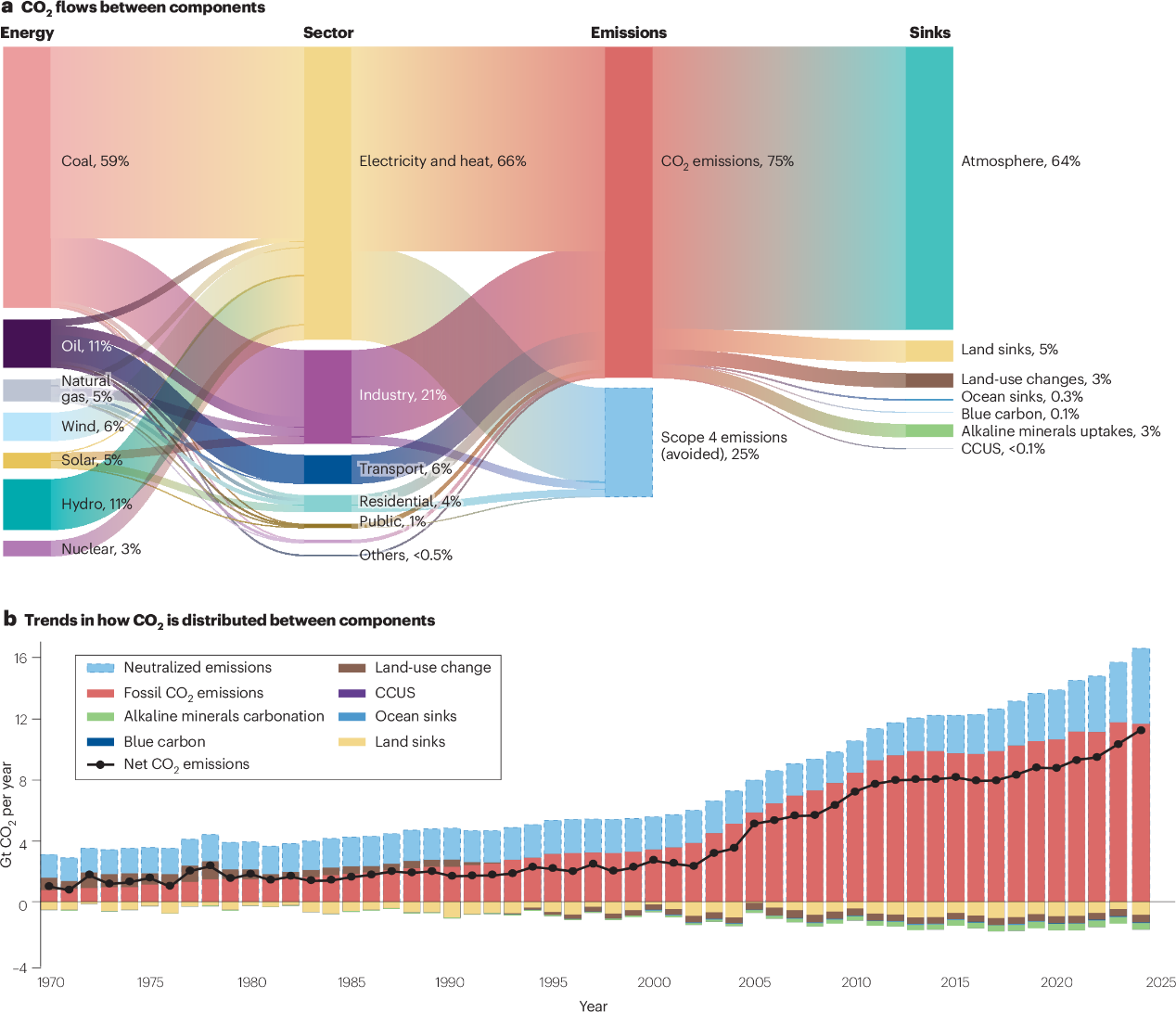
Fig. 2 The Components of China's CO₂ budget and their changes from 1970 to 2024.
The study further analyzes long-term changes in China's fossil fuel and industrial process emissions. It shows that China's terrestrial carbon sink has continued to strengthen over the past few decades. The CO₂ flux related to land-use change in China has shifted from a carbon source in the 1970s to a net carbon sink at present. The enhancement of the terrestrial ecosystem carbon sink is linked to factors such as long-term ecological restoration projects, forest growth, land management and environmental changes. However, the study also notes that the terrestrial carbon sink exhibits significant interannual variability and regional differences, and may be affected by climate change, extreme events, and changes in land-use management. Its long-term stability therefore requires continuous monitoring and assessment.
Towards the carbon neutrality goal of 2060, the study further estimates, based on scenario comparisons, that China needs to avoid a cumulative total of approximately 163 Gt CO₂ between 2025 and 2060 through fossil fuel substitution and energy efficiency improvements. Of this, non-fossil energy substitution could contribute about 120 Gt CO₂ of avoided emissions, and energy efficiency improvements could contribute about 43 Gt CO₂. By 2060, fossil fuel substitution could avoid about 3.6 Gt CO₂ per year, and energy efficiency improvements could reduce about 0.9 Gt CO₂ per year. However, even if these transition targets are achieved, the study projects that residual emissions of approximately 1.6 Gt CO₂ per year will remain by 2060, mainly from hard-to-abate sectors such as steel, cement and chemicals. For these sectors, material efficiency improvements, electrification where feasible, low-carbon hydrogen applications, and carbon capture, utilization and storage (CCUS) for process emissions will be important technological directions for achieving deep emission reductions.
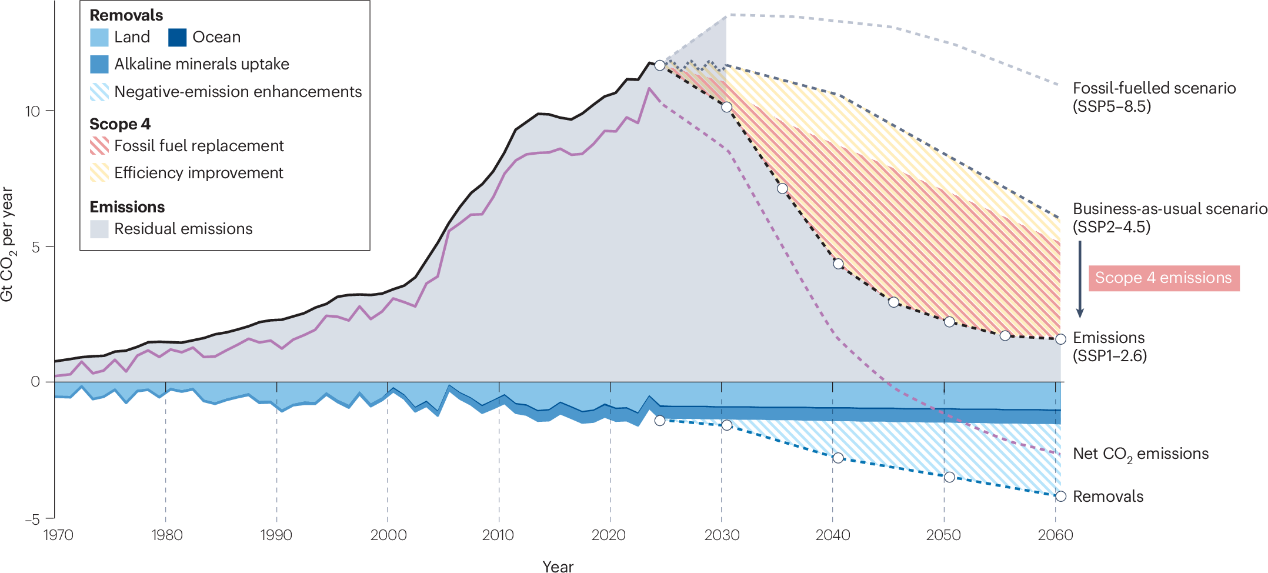
Figure 3 China's carbon neutrality pathway by 2060 based on the regional carbon budget
The study emphasizes that although natural carbon sinks and anthropogenic carbonation sinks play important roles, they cannot be simply regarded as equivalent, stable and permanent offsets to residual fossil fuel emissions. The study recommends promoting demonstrations and pilots in the 2020s and 2030s, reaching a scale of approximately 1 Gt CO₂ per year in the 2040s, and achieving integrated national-scale deployment in the 2050s. Establishing a high-precision, transparent and verifiable measurement, reporting and verification (MRV) system is key to supporting China's net-zero carbon budget and carbon neutrality pathway assessment. In the future, multi-source data including satellite remote sensing, ground-based greenhouse gas observing stations, continuous emission monitoring from key industries, forest and soil flux observations, and carbon sequestration monitoring should be integrated to improve the spatiotemporal resolution and verifiability of the regional carbon budget. At the same time, alignment with the IPCC guidelines for national greenhouse gas inventories and the enhanced transparency framework of the Paris Agreement should be strengthened to establish a more robust accounting basis for the contributions of Scope 4 avoided emissions and negative emission technologies.
The related research findings were published online in Nature Reviews Earth & Environment on May 20, 2026 under the title "China's net-zero budget". Professor Liu Zhu from the Department of Earth System Science (DESS), Tsinghua University, and Dr. Ke Piyu, a Ph.D. graduate of the same department and currently a Postdoctoral Researcher at Laboratoire des Sciences du Climat et de l'Environnement (LSCE), Université Paris-Saclay, France, are the co-first authors and co-corresponding authors. Collaborators are from Tsinghua University, the University of Hong Kong, the Second Institute of Oceanography (MNR), Shanghai Jiao Tong University, Northeast Forestry University, Shanghai Advanced Research Institute (CAS), the University of Science and Technology Beijing, Microsoft Research, the Hong Kong Polytechnic University, Nanjing University of Information Science and Technology, the Administrative Centre for China's Agenda 21, Xiamen University, the Chinese Academy of Meteorological Sciences, Fujian Ocean Innovation Center (Fujian-OI), as well as Université Paris-Saclay, the University of Exeter, CICERO International Climate Research Centre, Leipzig University, CSIRO, Stanford University, the University of California Berkeley, Université PSL, Sorbonne Université, École Polytechnique, the European Commission (Joint Research Centre), the University of East Anglia, the University of Michigan, Nagoya University, Yonsei University, and the International Institute for Applied Systems Analysis (IIASA), among other domestic and international institutions. The research was supported by the National Natural Science Foundation of China, the National Key R&D Program of China, and the Carbon Neutrality and Energy System Transformation (CNEST) program, among others.
Full-text link:
https://www.nature.com/articles/s43017-026-00791-1
Written by Liu Zhu and Ke Piyu
Edited by Wang Jiayin
Reviewed by Yu Le



 Picture News
 Hot News