As a vital component of the global carbon cycle, terrestrial vegetation sequesters atmospheric carbon dioxide through photosynthesis. Over the past few decades, global terrestrial gross primary productivity has exhibited an overall rising trend, yet its growth magnitude varies substantially across regions. Conventional studies have largely focused on how local climatic factors such as temperature and precipitation affect vegetation productivity, whereas there remains a lack of systematic understanding of the large-scale atmospheric dynamical mechanisms responsible for such spatial disparities.
Academician Deliang Chen’s team at Tsinghua’s Department of Earth System Science (DESS) has built an index for Northern Hemisphere westerly jet curvature variability using multi-source observational datasets, satellite remote sensing products and CESM large-ensemble climate model outputs, and systematically examined shifts in Northern Hemisphere westerly configurations from 1979 onward and corresponding impacts on terrestrial vegetation productivity. Results show that anthropogenic greenhouse gas emissions alter westerly jet curvature, which in turn coordinates and reshapes the spatial productivity patterns of Northern Hemisphere terrestrial ecosystems.
New findings in the research indicate that the Northern Hemisphere westerly jet has experienced pronounced spatial restructuring over the past four decades. In Eastern Europe, Northeast Asia and western North America, the jet’s curvature has gradually shifted from cyclonic bends to anticyclonic bends. By contrast, Central Asia and central North America exhibit the reverse transition—from anticyclonic to cyclonic curvature. On the whole, fluctuations of the Northern Hemisphere westerly jet have intensified across the hemisphere.
The research has revealed that these large-scale circulation shifts closely match the spatial distribution of terrestrial vegetation productivity variations from 1982 to 2018. In high-latitude zones including Northern Europe and Northeast Asia, warmer temperatures have eased cold limitations, driving marked gains in vegetation productivity. By comparison, regions such as Southern Europe and central North America have seen restrained productivity growth amid more frequent and severe heatwaves and droughts. Multiple productivity hotspots across the Northern Hemisphere show strong correlations with shifts in westerly jet curvature. Collectively, the results demonstrate that the Northern Hemisphere westerly jet not only exerts impacts on daily weather and extreme climate events, but also shapes the broad-scale spatial pattern of carbon sequestration across terrestrial ecosystems.
To identify the causes behind the westerly changes, the research team used CESM single-forcing large-ensemble simulations to assess the contributions of greenhouse gases, aerosols, and biomass burning emissions. The research has found that greenhouse gas emissions are the dominant factor driving changes in westerly curvature. In the identified hotspot regions, the contribution rate of greenhouse gas emissions ranges from 35% to 113%. The contributions of aerosols and biomass burning emissions are relatively small and subject to large uncertainties, with the overall change in Northern Hemisphere westerlies almost entirely dominated by increased greenhouse gases.
Under a high-emission scenario (RCP8.5), the research projects that the trend of increasing westerly curvature will continue, further influencing the future distribution of terrestrial carbon sinks. Vegetation productivity is expected to continue increasing in Northern Europe, Northeast Asia, and western North America, while productivity growth in Southern Europe and central North America is projected to slow down or even decrease. As a result, the carbon sink capacity of the Northern Hemisphere land will exhibit increasingly pronounced spatial heterogeneity.
The research emphasizes that future changes in global carbon sinks are influenced not only by the direct effect of rising CO₂ concentrations but also by the modulation of large-scale atmospheric circulation adjustments. Therefore, atmospheric dynamic processes need to be more fully considered when predicting future carbon cycle and climate feedbacks.
The research suggests that large-scale atmospheric circulation serves as an important bridge linking anthropogenic climate change and ecosystem responses. Changes in the Northern Hemisphere westerly jet can coordinate terrestrial vegetation productivity changes on a hemispheric scale. Traditional carbon cycle research focusing only on local temperature and precipitation changes may underestimate the role of large-scale atmospheric circulation in shaping spatial patterns. From the perspective of hemispheric-scale atmospheric circulation, this research reveals how anthropogenic climate change systematically reshapes the spatial distribution pattern of terrestrial Gross Primary Productivity (GPP) by altering the morphology of the Northern Hemisphere westerly jet. It provides a new scientific perspective for understanding global carbon cycle changes and future carbon sink evolution. The findings not only deepen our understanding of the driving mechanisms of the global carbon cycle but also provide important scientific foundations for improving future terrestrial carbon sink prediction capabilities and optimizing regional ecological management and climate adaptation strategies.
These results have been published in Nature Communications under the title "Human-induced westerly jet shifts coordinate terrestrial productivity at the hemispheric scale."
Dr. Yang Xiaoye from the University of Gothenburg, Sweden is the first author, and Academician Chen Deliang, Academician at the Department of Earth System Science, Tsinghua University, serves as the corresponding author. The research was completed in collaboration with scholars from Sweden, China, and the Netherlands.
Full-text link: https://www.nature.com/articles/s41467-026-74039-3
Written by Chen Deliang and Yang Xiaoye
Edited by Wang Jiayin
Reviewed by Yu Le
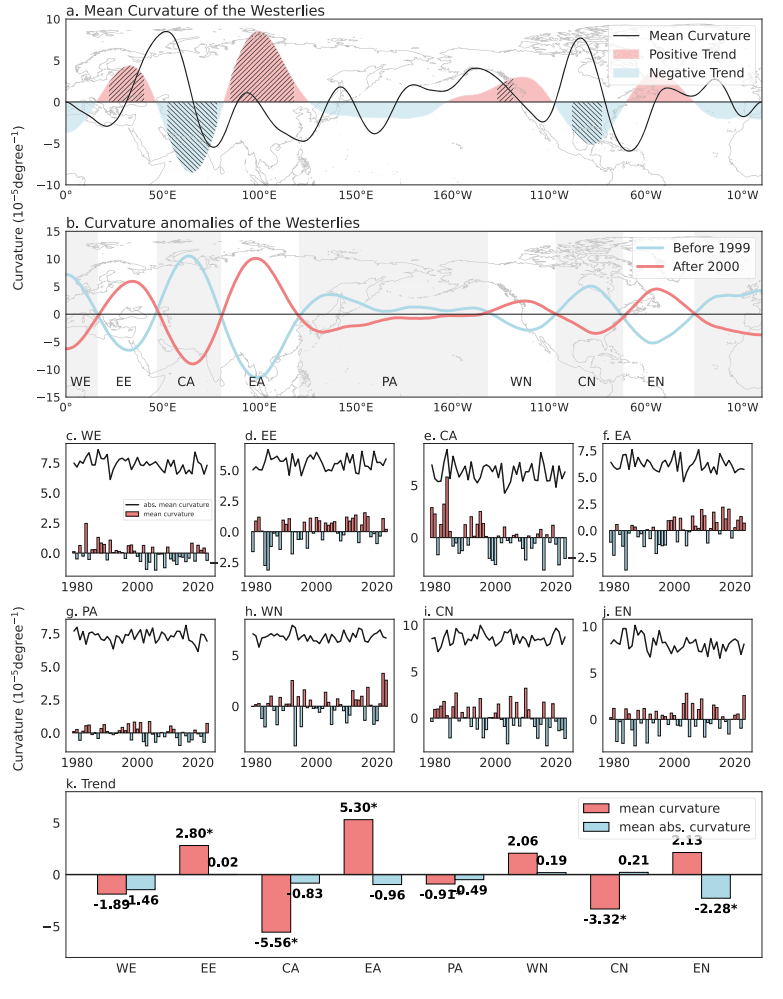
Fig. 1 Summer westerly curvature in the Northern Hemisphere and its changes during 1979–2023.
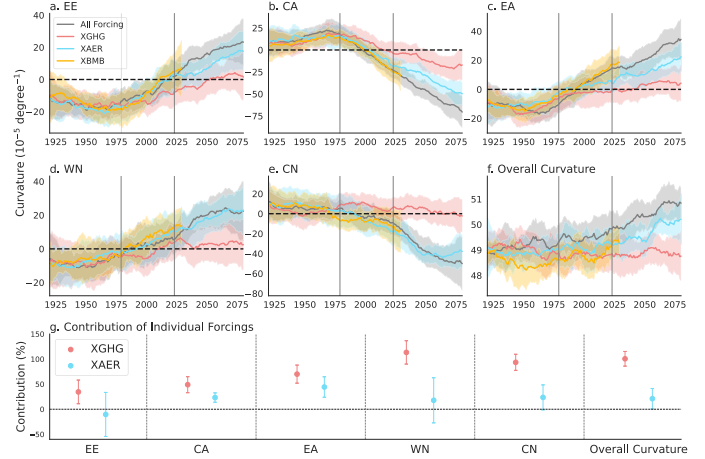
Fig. 2 Effects of different forcings on westerly curvature under the RCP8.5 scenario.



 Picture News
 Hot News