Hospitals are critical infrastructure for mitigating the health risks of climate change, playing a key role in protecting public life and health, providing continuous medical services, and supporting urban emergency response. However, as extreme precipitation and urban flooding risks intensify, hospitals themselves are increasingly exposed to climate threats. How to scientifically assess the flood risks faced by hospitals under future climate change, quantify the associated economic losses and health impacts, and develop cost-effective adaptation strategies has become an urgent issue for enhancing the climate resilience of healthcare systems.
To address this problem, a collaborative research team led by Professor Wenjia Cai from the Department of Earth System Science (DESS) and Associate Professor Xin Dong from the School of Environment (SOE) at Tsinghua University constructed a database of general hospitals in China and an urban flooding model. The team integrated high spatiotemporal resolution precipitation data (9 km, 15-minute intervals) to estimate the maximum water depths that hospitals could face under future climate change scenarios. Based on this, the study systematically quantified the direct economic losses and health impacts (due to diagnostic delays) from urban flooding on approximately 14,000 hospitals across 337 Chinese cities. It also compared the differences in risk under scenarios with and without adaptation measures.
The study found that under a medium warming scenario (SSP245), even if all hospitals were fully adapted to 2020 urban flooding levels, by the 2080s, annual direct economic losses to Chinese hospitals from urban flooding would rise to US$9.1 billion (95% CI 8.0–10.1). This is equivalent to 6.9% of China's 2022 government medical insurance expenditure. Meanwhile, the number of people affected by diagnostic delays would reach 6.8 million (95% CI 4.5–9.6). Under a higher warming scenario (SSP585), these losses and impacts would increase by approximately a further 50%.
The study further evaluated the cost-effectiveness of different adaptation strategies. Results show that a uniform national adaptation strategy would require an investment of US$51.2–97.4 billion to reduce hospital urban flooding losses to near zero. In contrast, a cost-effective, city-specific and hospital-specific strategy would require only US$8.2–11.9 billion to achieve a similar level of risk reduction. This indicates that fine-scale assessments tailored to the risk characteristics of different cities and hospitals, along with differentiated adaptation plans, can significantly lower adaptation costs and improve the efficiency of investments in climate resilience.
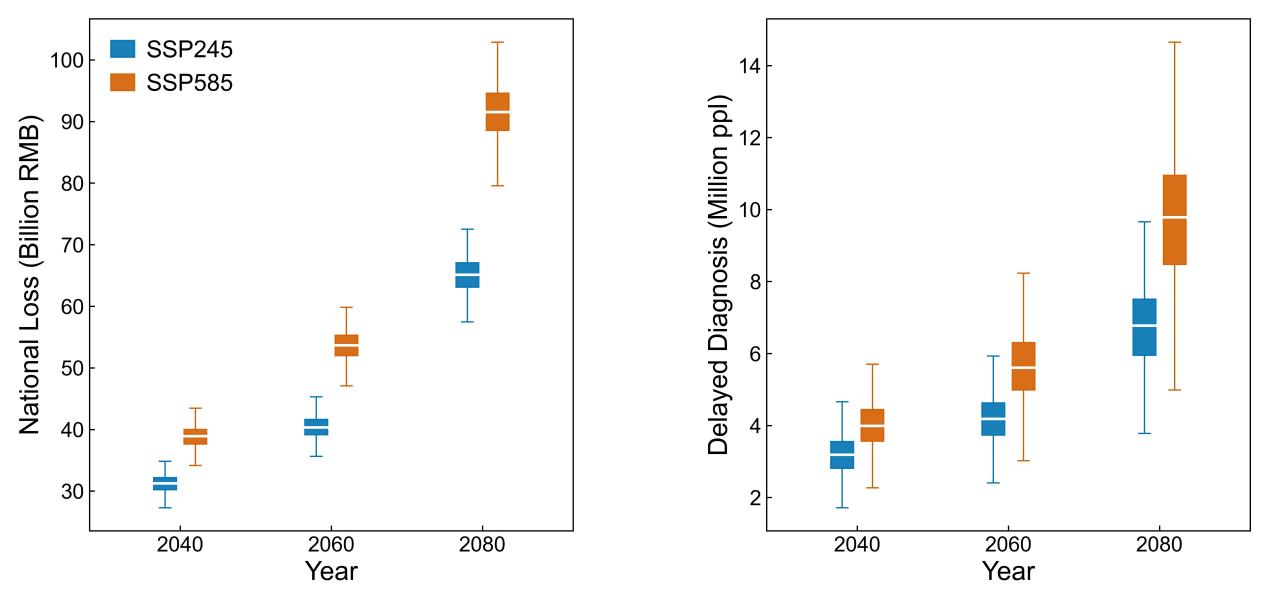
Fig. 1 Impact of urban flooding on hospitals under no adaptation measures.
The study highlighted that climate change poses a severe and growing threat to hospital systems. Large-scale, long-term flood risks will not only increase hospital operational burdens but may also weaken the capacity of healthcare systems to safeguard public health. Therefore, enhancing hospital climate resilience requires hospital-level small-scale risk identification, loss assessment, and evaluation of adaptation measure effectiveness. This can provide scientific evidence for urban planning, healthcare resource allocation, and emergency management. The hospital-level urban flood risk assessment framework and adaptation strategy optimization method proposed in this study can offer quantitative support for building more resilient healthcare systems and reducing the future health risks of climate change.
The findings were published on June 10, 2026 in The Lancet Public Health under the title "Hospital-level urban flood risk assessment and targeted strategies to increase hospital climate resilience in China." Zhang Shangchen, a Class 2022 PhD candidate in the Department of Earth System Science (DESS) at Tsinghua University, is the first author. Li Ruyi, a Class 2022 PhD candidate in the School of Environment (SOE) at Tsinghua University, is the second author. Professors Cai Wenjia and Dong Xin are the co-corresponding authors.
Full-text link:
https://doi.org/10.1016/S2468-2667(26)00072-1
Written by Zhang Shangchen and Cai Wenjia
Edited by Wang Jiayin
Reviewed by Yu Le



 Picture News
 Hot News