Global carbon emission fluctuations and the low-carbon transition of energy systems constitute a core basis for measuring the outcomes of global climate governance and prospective warming risks. Professor Liu Zhu’s Research Group of the Department of Earth System Science (DESS), Tsinghua University, in collaboration with the University of Hong Kong, the International Institute for Applied Systems Analysis (IIASA), Stanford University and France’s Laboratory of Climate and Environmental Sciences (LSCE), has evaluated global CO₂ emission changes in 2025, the driving factors across major sectors, diverging emission trends among key economies, and the contribution of non-fossil energy development to emission reductions. Their findings, drawing on near-real-time data from Carbon Monitor and Carbon Monitor-Power, provide a key scientific foundation for evaluating the effectiveness of global climate governance and future warming risks.
The study indicates that global CO₂ emissions from fossil fuel combustion and industrial processes reached 37.2 ± 0.3 Gt CO₂ in 2025, representing a 0.7 ± 0.7% increase relative to 2024. Among the sectors, CO₂ emissions from the power sector decreased by 0.9% year-on-year, while industrial emissions grew by 2.1%, building sector emissions rose by 1.9%, and emissions from international and domestic aviation increased by 5.4% and 2.5%, respectively.
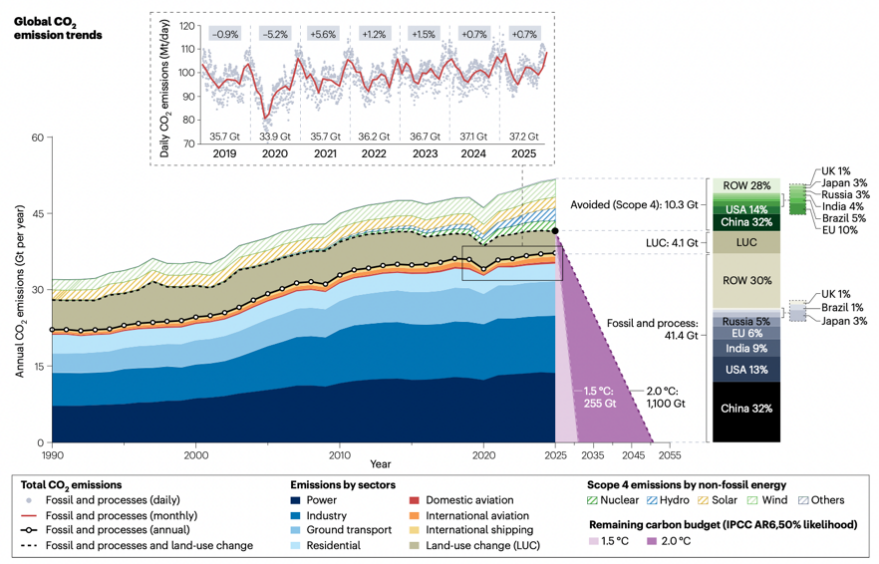
Figure: Global CO₂ emission trends, sectoral structure, regional contributions, and avoided emissions of non-fossil energy in 2025.
The research highlights that the large-scale deployment of non-fossil energy is a major driver behind the decline in power sector emissions. In 2025, global non-fossil electricity generation was estimated to have grown by 5.9%, reaching 13.7 PWh—equivalent to avoiding approximately 10.3 Gt CO₂ emissions, a volume comparable to the combined annual emissions of the United States, India, and the European Union. Growth in renewable energy was especially remarkable, with wind and solar generation increasing by 9.4% and 17.1%, respectively.
At the national and regional level, major global emitters saw pronounced divergence. China and India exhibited a slowdown in emission growth, showing signs of entering an emission plateau. China’s total emissions fell by 0.6% in 2025, with non-fossil electricity generation projected to rise by 13% to 4.4 PWh, avoiding about 3.3 Gt CO₂ emissions. India’s non-fossil electricity generation increased by 16%, with solar, wind, and hydropower jointly driving a decline in thermal power generation. In contrast, the United States and the European Union experienced emission rebounds, rising by 1.4% and 0.8% respectively, reflecting the risk of slowing low-carbon transition momentum and a resurgence in fossil fuel consumption in some developed economies.
The study indicates that the 2025 global carbon emission landscape bore dual implications: the drop in power sector emissions proved that clean power expansion had gained practical capability to reshape emission structures. Nonetheless, total global emissions stayed at historically high levels, and structural progress in a single sector failed to reverse the overall climate trajectory. The key to subsequent global emission reduction lay not only in hitting emission peaks, but also in expanding partial energy substitution into systemic reduction of fossil fuel reliance, accelerating the shift of global carbon emissions from the plateau period to a continuous downward trend.
These findings have been published as an annual review article titled “Global carbon emissions and decarbonization in 2025” in Nature Reviews Earth & Environment. Professor Liu Zhu of Tsinghua DESS is the corresponding author, and Dr. Deng Zhu, a DESS doctoral graduate and currently a postdoctoral fellow at the University of Hong Kong, is the first author. This research was supported by the National Natural Science Foundation of China, the National Key Research and Development Program of China, and the Carbon Neutrality and Energy-Interconnection International Science and Technology Cooperation Project.
Full-text link to paper: https://www.nature.com/articles/s43017-026-00780-4
Written by
Edited by Wang Jiayin
Reviewed by Yu Le



 Picture News
 Hot News