Against the backdrop of global warming, extreme climate events have occurred with increasing frequency, and wildfires have become one of the critical factors threatening ecosystem stability and biodiversity. Nonetheless, existing studies have mainly focused on long-term habitat degradation induced by climate change, while there remains a lack of systematic and comprehensive assessment on “acute disturbances” — especially the long-term impacts of climate-driven wildfires on species extinction risk.
To address this research gap, the Research Group led by Academician Chen Deliang from the Department of Earth System Science (DESS), Tsinghua University, in collaboration with scholars from Sweden, the United States, the United Kingdom and other countries, has systematically evaluated the impacts of intensified wildfire activity under climate change on species survival risk at the global scale. The findings reveal substantial disparities in future wildfire exposure risks across regions and species, offering important scientific support for global biodiversity conservation and climate risk governance.
The study integrated outputs from 13 CMIP6 climate models, combined with a machine learning model (LightGBM), to project changes in burned area over the 21st century. The Canadian Fire Weather Index System was employed to assess changes in fire season length. The team systematically analyzed wildfire risk for 9,592 terrestrial species identified by the International Union for Conservation of Nature (IUCN) as threatened by increased fire activity. The assessment was further extended to a dataset of 41,543 non-marine species—encompassing both wildfire-threatened and non-threatened species—and established the first global assessment framework for species wildfire exposure risk based on future projected increases in burned area and fire season length.
Under the moderate emissions scenario (SSP2-4.5), the study projects that by the end of the 21st century, global burned area will increase by approximately 9.3%, and the global fire season will lengthen by 22.8%. A total of 83.9% of fire-threatened species will face elevated wildfire exposure risk, with nearly 40% of South American species experiencing an increase in burned area exposure exceeding 50%.
High-latitude regions show the most pronounced increases, with fire season length more than doubling in some areas. This implies that cold-climate ecosystems, which historically experienced few fires, will face emerging wildfire threats in the future. In contrast, parts of Africa are projected to experience declines in burned area, highlighting a distinct spatial asymmetry. Such regional disparities underscore the complexity of climate change impacts on global ecosystems.
The study further finds that species with smaller geographic ranges tend to experience greater increases in wildfire exposure. The top 1% most affected species (96 species) are concentrated primarily in South America, South Asia, and Australia, with Endangered (EN) and Vulnerable (VU) species significantly overrepresented. Range-restricted taxa in South America, particularly amphibians, face especially acute wildfire risk. These findings suggest that climate-driven wildfire intensification could further exacerbate the extinction risk of already vulnerable species.
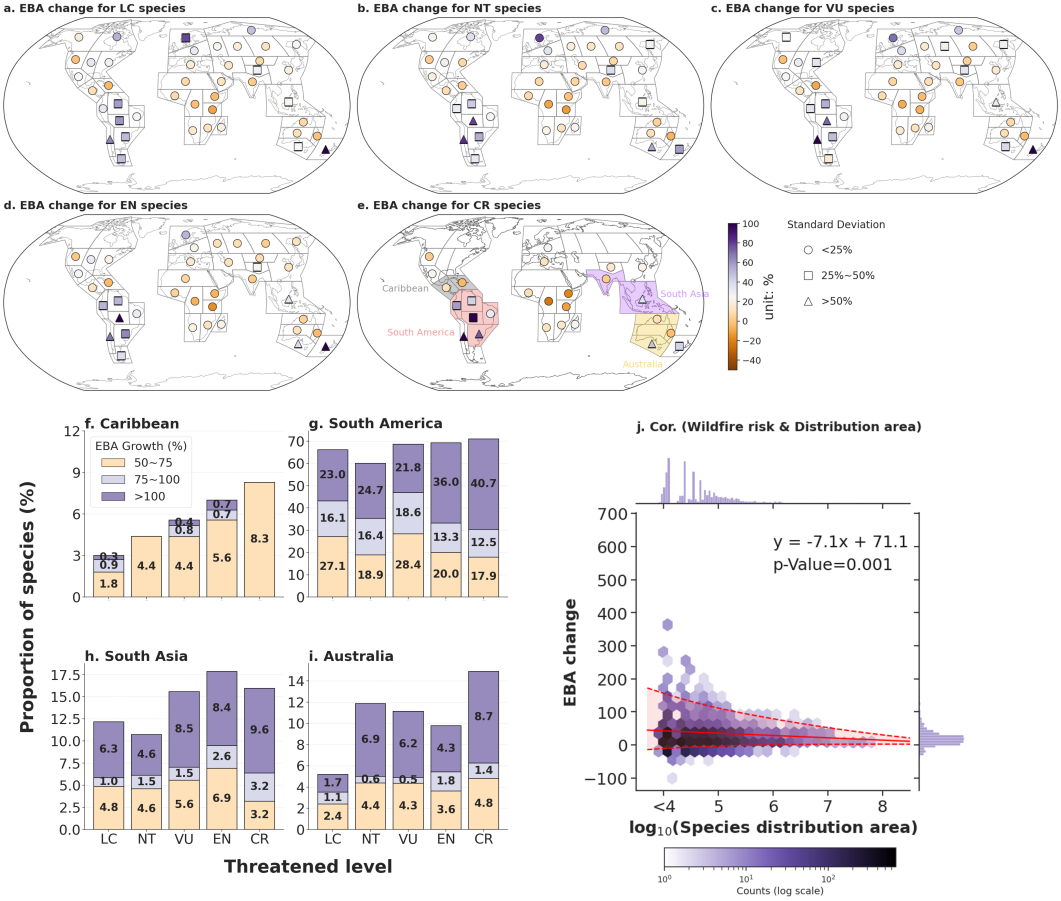
Figure 1. Projected changes in species exposure to wildfire burned area by the end of the twenty-first century under SSP2-4.5. (a–e) EBA change for species grouped by IUCN threat categories; (f–i) Proportion of species experiencing different levels of EBA change in selected hotspot regions; (j) Relationship between projected EBA change (%) and species’ distribution size.
The research also evaluates "avoidable threats" under different emission pathways. Compared to the high-emissions scenario (SSP5-8.5), the moderate-emission pathway (SSP2-4.5) could reduce the global increase in species burned area exposure by 63.4%. Species in New Zealand, South America, and high-latitude regions of the Northern Hemisphere stand to benefit most from emissions mitigation, with high-latitude species showing particular sensitivity to emission trajectories. The study underscores that strengthening global climate mitigation efforts would not only help limit warming but also significantly reduce the future impact of wildfires on biodiversity.
The study highlights that future wildfire risk will expand poleward, and that current species assessment frameworks, which are largely based on existing threats, may underestimate future risks. The authors emphasize the need for targeted region-specific conservation strategies, and stress that it is critical to incorporate climate-driven "acute disturbances"—including wildfires—into conservation planning, rather than focusing solely on "chronic disturbances" such as habitat degradation from slow climate change.
This research provides a new scientific perspective on the complex feedback mechanisms between climate change and biodiversity, while also offering quantitative evidence to inform international climate governance and ecological conservation policies. The findings were published in Nature Climate Change under the title "Wildfire risk for species under climate change." Dr. Yang Xiaoye from the University of Gothenburg is the first author, and Professor Chen Deliang of Tsinghua University is the corresponding author.
Full-text link to paper:
https://www.nature.com/articles/s41558-026-02600-5?sessionid=
Citation: Yang X., Urban M.C., Su B., Zhong Z., Wu C., Chen D. (2025). Wildfire Risk for Species under Climate Change. Nature Climate Change.



 Picture News
 Hot News