Symposium explored the lasting consequences of warming overshoot, risks to water and coast systems, and how international research can inform local responses.
Global climate findings carry practical implications for water management, coastal adaptation, and ecosystem protection. How can international research better inform those decisions, and how can regional experience help shape the research?
These questions brought climate scientists, international research networks and emerging scholars together in Beijing on 20 October for “Future Earth and Climate Change Science,” a satellite symposium held alongside the 2026 International Science Council (ISC) Midterm Members’ Meeting and Beijing Science Dialogue.
Presentations and discussions at the symposium co-organized by Future Earth and held at Tsinghua University’s Institute for Carbon Neutrality examined how scientific collaboration across disciplines and regions can help connect climate research with societal needs.
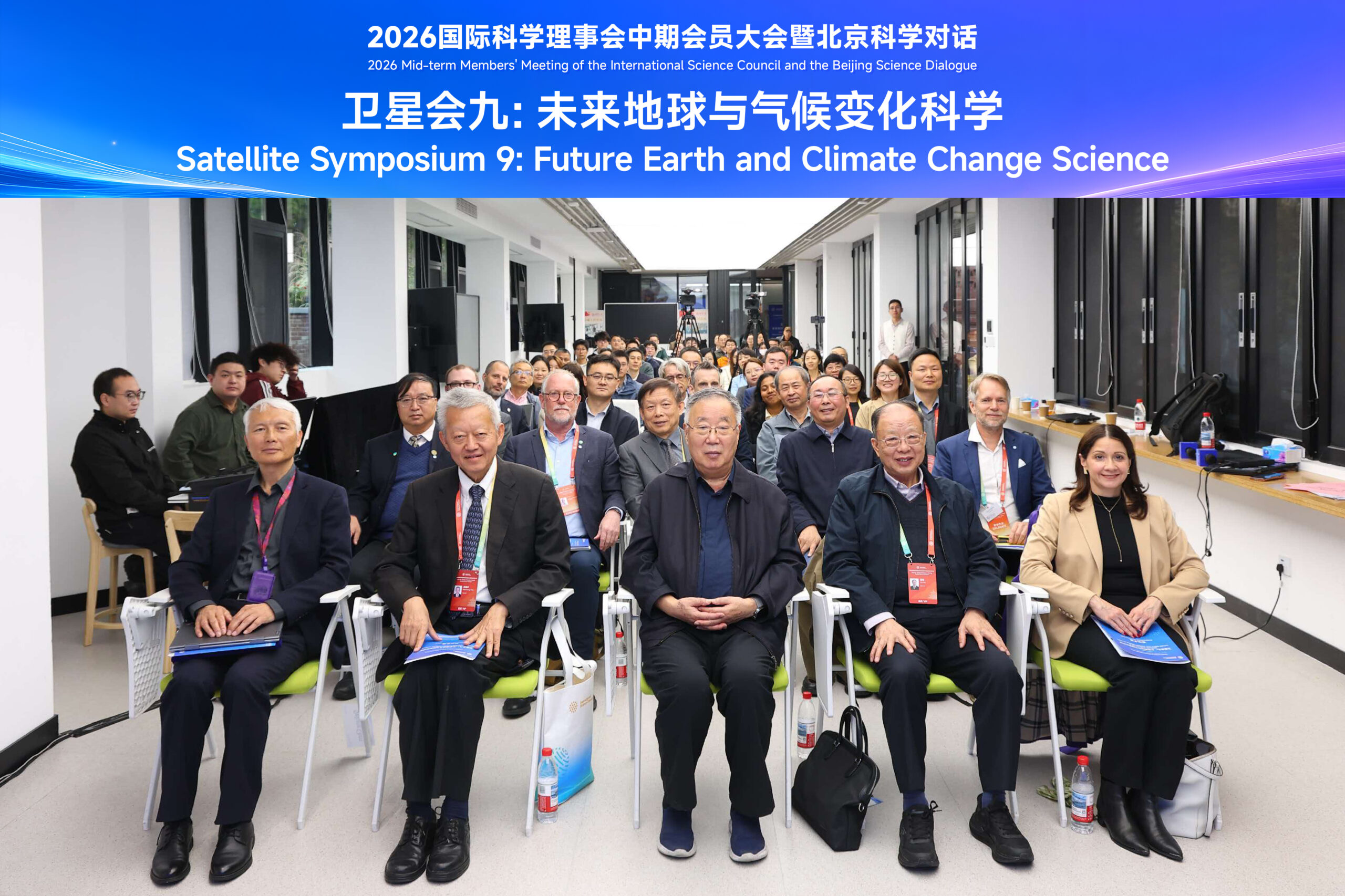
Scientists and representatives of international research networks at the symposium in Beijing, 20 October 2026.
Connecting global findings with regional challenges
The consequences of temporarily exceeding global temperature thresholds were a central theme. Future Earth Governing Council Co-Chair Deliang Chen explained that a subsequent decline in temperature would not necessarily reverse changes to ice sheets, sea levels, regional climates or ecosystems. He emphasized faster emissions reductions, minimizing warming overshoot and carefully assessing the implications of large-scale carbon dioxide removal.
Water security offered a regional perspective on these challenges. Drawing on floods and droughts in China’s Yangtze River basin, Jun Xia highlighted the need to combine monitoring and forecasting with reservoir operations, floodplain management, insurance and other measures.
Coastal risks also illustrated the importance of connecting global projections with local conditions. World Climate Research Programme (WCRP) Chair TImothy Naish discussed how land subsidence, coastal landforms and tides influence local exposure to rising seas, and emphasized developing flexible adaptation strategies with affected communities.
Yonglong Lu examined the combined pressures of climate change and pollution on coastal ecosystems, highlighting integrated monitoring and restoration. especially in coastal environments, emphasizing integrated monitoring and restoration. Baojing Gu explored how warming, elevated carbon dioxide and changing rainfall affect carbon and nitrogen cycles in croplands, grasslands and forests.
Together, these presentations highlighted the need to consider interacting environmental pressures when assessing risks and planning responses.
Jakob Lundberg, Deputy Director of the Future Earth Sweden Hub, presented findings from the 10 New Insights in Climate Science 2026/2027, an annual synthesis produced by Future Earth, The Earth League and WCRP. His presentation highlighted ocean heat accumulation and the long-lasting implications of rising seas, connecting the synthesis with coastal challenges discussed throughout the symposium.
Making Science Useful for Decisions
Opening remarks from Dahe Qin, Chair of the Chinese National Committee for Future Earth, and ISC Governing Board member Frances A. Colón emphasized interdisciplinary research and closer connections between science and society.
Colón called for earlier engagement with policymakers and communities, stronger cooperation between natural and social sciences, and greater opportunities for young researchers to contribute and lead. In a subsequent presentation, she explored how international science informs climate policy and helps sustain action amid political change.
Afternoon sessions brought together representatives of Future Earth research networks, programs associated with the International Union of Geodesy and Geophysics (IUGG), and the Intergovernmental Panel on Climate Change (IPCC) assessment community..
A young scientists’ forum included contributions on systemic risk, coast and ocean sustainability, and ecological compensation, with participation from researchers associated with the Integrated Risk Governance Project (IRGP), Future Earth Coasts, the Integrated Marine Biosphere Research project (IMBeR) and the Water–Energy–Food Nexus Knowledge-Action Network.
A closing roundtable moderated by Bo Su of the Earth Commission Secretariat explored interdisciplinary cooperation, translating research into practical action, and supporting young scientists.
Across the program, a recurring message was that useful climate science requires both an understanding of global change and attention to the environmental and social conditions that shape regional responses.
About the symposium
The symposium was co-organized by Future Earth and international and Chinese scientific partners. See the ISC event program for the full list of organizers and sessions.



 Picture News
 Hot News

