On July 12, Academician Chen Deliang, Dean of the Department of Earth System Science (DESS) at Tsinghua University, attended by invitation the cross-disciplinary salon "When Science Meets Art: The Science and Poetry of the Twenty-Four Solar Terms," held at the National Centre for the Performing Arts. The event was co-hosted by the Center for Public Communication and Education of the Ministry of Ecology and Environment, the National Centre for the Performing Arts, the Beijing Association for Science and Technology, the Key Open Laboratory of the Twenty-Four Solar Terms of the China Meteorological Administration, Peking University Press, and the Beijing Science Journalists Association. Through an innovative format that combined popular‑science lectures, instrumental performances, vocal performances, and literary recitations, the event unlocked the natural‑scientific codes and Eastern humanistic poetry embodied in the Twenty‑Four Solar Terms.
Against the melody of "An Unexpected Encounter," a solo guitar piece by Liu Xianji, Chen Deliang delivered a lecture titled "When the Twenty‑Four Solar Terms Meet Climate Change." As a leading scientist deeply engaged in global climate research, Academician Chen began with the Sun — the fundamental driving force behind the formation of climate — and pointed out that the Twenty‑Four Solar Terms are demarcated according to the astronomical laws governing the relative motion of the Sun and Earth, embodying the wisdom the Chinese nation has accumulated through long‑term observations of seasonal cycles.
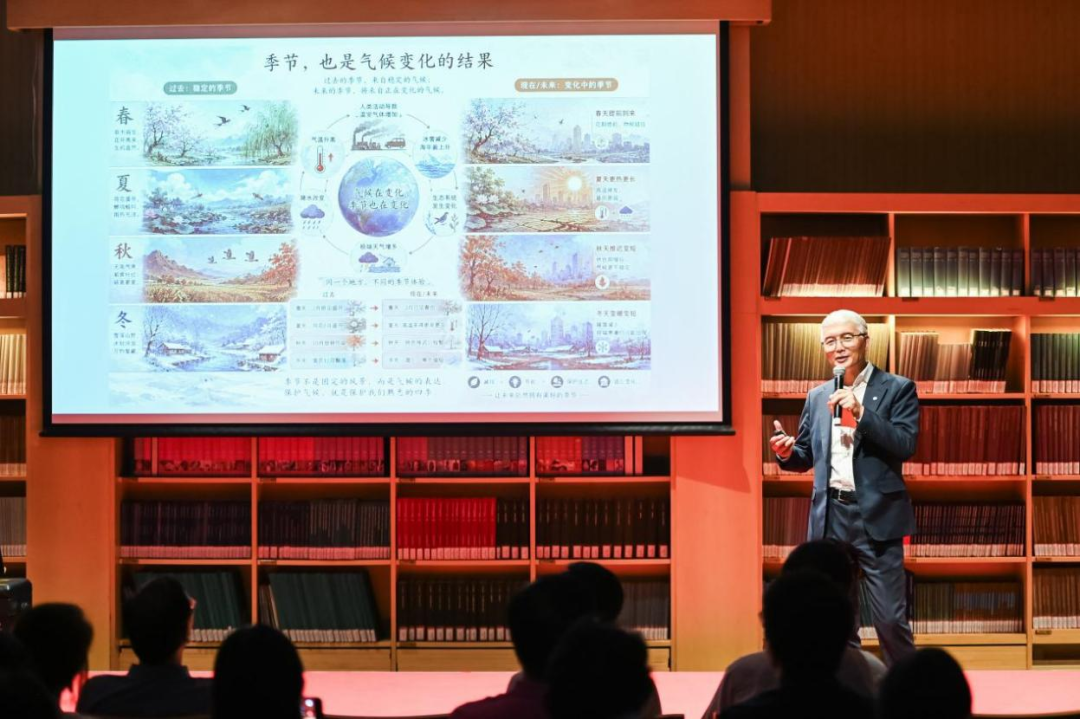
Chen Deliang delivering his lecture
Chen Deliang noted that human civilization could flourish only under the relatively stable climatic conditions of the past 10,000 years. Since the Industrial Revolution, however, human activities have come to influence climate change. As an astronomical calendrical system, the Twenty‑Four Solar Terms will not alter with global warming, yet their climatological significance is shifting — seasons are arriving earlier or growing longer, and the solar terms are evolving from objects of nostalgia into "cultural sensors" for observing climate change. He explained that the past of the Twenty‑Four Solar Terms chronicles humanity’s adaptation to the rhythms of nature, while their future offers a cultural opportunity for humankind to reinterpret climate change and restore the relationship between humans and nature.
Under the theme "The Science and Poetry of Solar Terms", the event took the twenty‑four solar terms as a thread connecting past and present and immersed audiences in nature and humanistic heritage. Through this compelling intersection of science and art, participants gained insight into the Eastern wisdom of ancient people observing celestial and terrestrial phenomena, as well as the far‑reaching impacts of climate change on traditional seasonal timelines. Guests present at the event included Yan Shidong, Party Secretary and Director of the Center for Public Communication and Education of the Ministry of Ecology and Environment; Zhu Jing, Vice President of the National Centre for the Performing Arts; and Li Zhanjun, Chair of the Editorial Board of China Science Daily and Vice‑Chair of the Beijing Association of Science and Technology Journalists.
Edited by Wang Jiayin
Text & Photos: National Centre for the Performing Arts
Reviewed by Chen Deliang and Yu Le



 Picture News
 Hot News